
Chronovisor: Interview with Star and Behavioral Scientist, Anne-Laure Sellier
For a film billed as a tech thriller, Chronovisor is insistently analog. Other than a few brief conversations on an iPhone, one of the only clues that the film is set in the present day is the date printed on a typewritten letter.
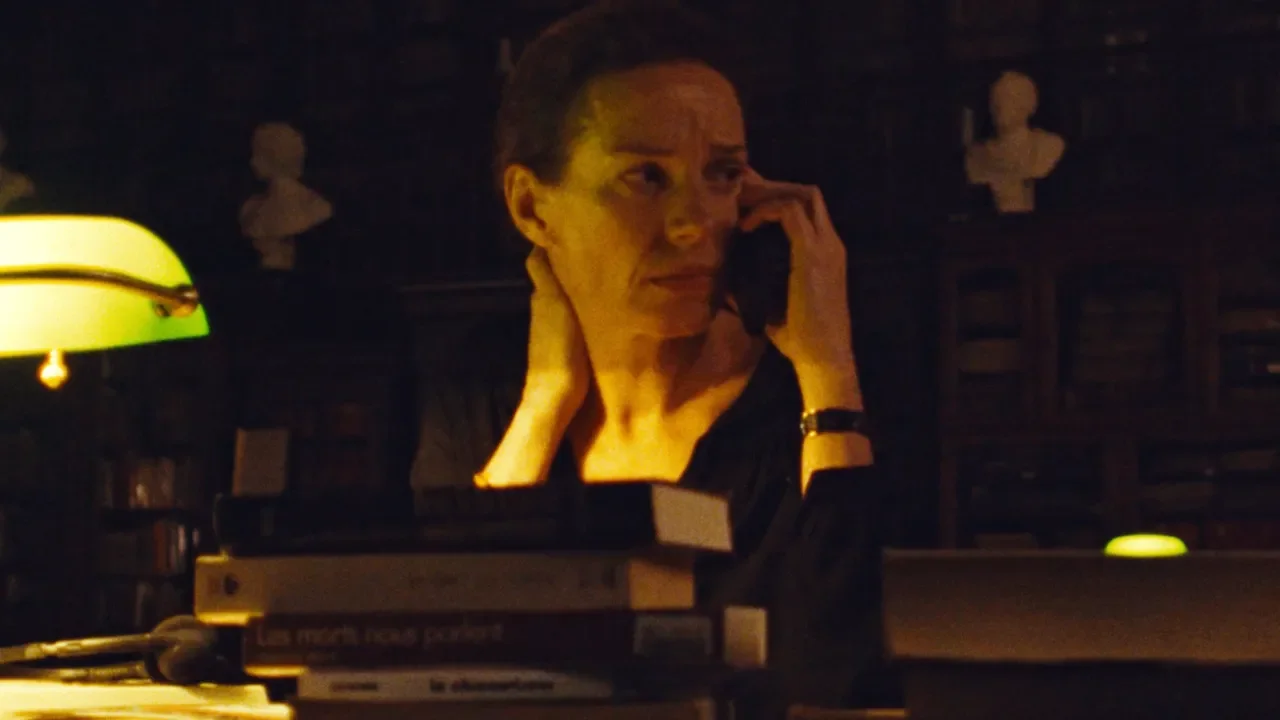
This approach resonated with the film's unlikely star, real-life behavioral scientist Anne-Laure Sellier, who plays an academic on the hunt for a fabled device that can record mankind's collective memory. She worries that the digital age is stripping the essential struggle from academic life.
Told through shots of books and fragments of text set to the music of Gustav Holst, Chronovisor invites the viewer down a research rabbit hole, one that offers the rare satisfaction of a payoff at the end. As a science journalist who interviews academics for a living, I set up a Zoom call with Sellier from her home in Paris to learn how the movie relates to her real-world experience in academia.
This interview has been edited for length and clarity.
Hyperreal Film Club: Tell me how you got involved in a film project.
Anne-Laure Sellier: I received an email from Jack [TK] and Kevin [TK], the two directors of Chronovisor. At first, I thought it was a bot that sent a request for some money, and I was about to delete it. But the way the email was written, and in particular the fact that Jack mentioned that he was both a film student at NYU and an MBA student, I thought that has to be real because that's way too sophisticated at that point in time for a bot. He provided a description of the project that was so attractive for me, fed by literature, previous films and by an intellectual idea that I agree with.
I auditioned, they were clear they wanted me, and the problem was the logistics because I'm faculty now in Europe. I happened to come to New York to NYU, which is my former position, every May and June for a few weeks, where I do research. Usually, I protect my time insanely. They managed to organize the whole shooting of the movie, which involved several locations, exactly when I was there, while allowing me to do my job.
We did a lot of the movie shooting at night, and then we blocked four days at the end of June to go to Baltimore, where we did quite a bit of shooting as well. And then they came to Portugal to my house during my vacation, so that's how we managed to nail it.
You said that this project involved an intellectual idea that you agree with. What do you mean by that?
I love this movie because intellectually it puts us in front of the fact that, however fast and impressive human progress is, we still don't know where we're going.
And it seems to Jack and Kevin and I that knowledge is something we need to protect, and something that some people don't want to go around democratically, and dangerous. And the movie is also about that. And then the movie is also confronting us to the idea that truth is not always objective.
If you’ve seen the movie Fjord –
Not yet, no.
You should. It’s funny how it’s probably in the zeitgeist, but there's a lot of overlap in what we're getting at, which is, what's progress? What's knowledge that's positive, and what is it that we should be looking for?
In my research, I write papers that are very rational. I'm always careful not to go beyond the data. We're extremely constrained, and we appeal to reason. What I loved about [Chronovisor] was to have a way of expressing what I express in my research, and put it in a format that appeals to emotions. It’s still not very democratic. It’s an indie movie, it’s super intellectual. But I’ve had the pleasure to attend festivals with Kevin and Jack to meet people I don’t usually meet, and that’s exciting, to share your worldview via an emotional channel.
You said that knowledge needs to be protected, and you don’t think that’s the case in our society right now. What are changes you would want to see that would help safeguard knowledge?
We've seen mega AI companies buying books and inhaling them and destroying them. There's a distinctive time during which we burned books in our history and that was not a happy time, and I think it's similar. Why would you burn books? That is crazy, especially rare books, right?
Also, the interpretation of knowledge is also an education. With social media, unfortunately, you get scientific findings, sometimes real scientific findings to be shared, but with shortcuts. I've had that issue with the research I published in 2017, which was portrayed very deceptively in the media because they wanted to sound sensational. Sometimes [science] is sensational. You know, you find the cure for cancer one day; it's going to be sensational. More often than not, research is not sensational. It's one one not even one step at a time, one toe at a time.
Something that I used to love when it appeared because anyone could see the benefits was TED. Isn’t that great? Fifteen minutes.
Yeah, so democratic.
You learn about a researcher, and you’re like “Oh, that’s wonderful.” The problem is fifteen minutes. I did a TED Talk, and you have to simplify. I give them a sense of why what I do matters, but the format is so unfit for the content that you do your best. But then someone is going to take minute three to four of that talk and take out all the rest, and all of a sudden, people believe one thing is true all the time, when in the talk you've been qualifying it. Knowledge needs time, knowledge needs conversation, knowledge requires critical thinking, which we critically miss today.
Chronovisor is an ode to research. You see the importance, in particular, of the friction in research. When you have books and tapes, and you're typing on a typewriter, everything is hard. If you read Ghost Stories by Siri Herczyk, the wife of the widow of Paul Oster, she mentions that Oster used to type all his books [on a typewriter] even to death. He could have switched to the computer, and he didn't. Following that book, I did exactly the same because [I’m writing] a book right now, and for whatever reason, I need to type that book. There are things that I'm happy to type on the computer. I do my taxes with Claude now. But for this book, I have an Olympia typewriter from 1960.
What are you writing?
It’s a novel. I’ve been wanting to do that for many years. I have many things to say as a professional who thinks about human behavior the whole day, and research is great, but it's never gonna land in the same way.
As a science journalist, one of the things that really resonated with me about the movie was this idea of becoming captivated by an idea and following it and holding it close to your chest, because you're not sure that it's going to pay off. Is that something that you've experienced in your research?
All the time. That's where I call it an ode to research, because you show the obsession and you show that you don't know where you're going. Researchers are very courageous because they are ready to lose themselves. And Beatrice is clearly that type. We spend months setting up experiments or collecting data, often for nothing.
That obsession also is one aspect of the movie that's so well translated by the music of Gustav Holst. I find that the music is almost more a character than me because it’s my head, and that's what we share with the viewer. You couldn't possibly have books for an hour and a half. You need to have some vessel where the viewer can go, like, “this woman is kind of silly and nerdy.” Then at some point, because of the reading, they become me. This transfer, that’s the magic of the movie.
You've described your character as a surrogate for the audience, and also talked about how you've had similar experiences in your own research, but were there any things you added to the character, from outside of you?
I am not Beatrice. Beatrice is a schizoid personality. I hope I am a little more average than that. Jack and Kevin gave me great books to read about madness in academia, of mental illness. So I composed her character. I talked for hours with Jack and Kevin, of who she was, what her values were. Is she a believer? How often does she have sex? Does she have a pet? Does she have a boyfriend? I won't give you the answers to all these questions. What you don't see about Beatrice in the movie, I know. I was in Paris and I started living like Beatrice. I worked off of real academics I know and academics I read about who were not your regular social animal
Jack and Kevin sent me pictures of how they would like me to dress. They also encouraged me to watch Tár.
Tár is my favorite movie.
And you know how she is, right? These towering people, arrogant. Cate Blanchett sits for an interview in the beginning of Tár, and Adam Gopnik pays her a compliment and she responds with an obnoxious “thank you.” It's kind of funny because in my TED Talk, which is what Jack and Kevin looked at when they [cast me], I arrive and I go “thank you.” I heard myself say it, and I was like, “oh my goodness, that’s obnoxious.” But I think [the directors] liked that, and they liked my black turtleneck and the French accent.
So back to your question, she was completely someone else, and this was also part of the fun of the movie. Acting is fun when you are in a very cerebral kind of work because in acting, you go with your emotional, moment-to-moment experience.
You talk about how you've embraced friction in your work. Is this something that you've tried to instill in your students?
Not really. I think it's a very personal thing. My research colleagues mock me because they say, "Oh, if there's something hard to do, that's what you're going to do.” It's kind of funny because yes, often I fail, but when I succeed, it’s big news when the hard stuff works.
In my own research, I do crazy field studies. I did a study in a yoga studio with 100 of my students. They took hot yoga for an hour and a half. I had yoga instructors who were there supposedly for training, who were taking notes of who held the pose and who fell out of the pose, to see what the presence of a clock did to the yoga practice, and found similar results as in the lab. It was a very difficult study to administer, but eventually the paper got published, and all my colleagues were talking about the yoga study.
Did your colleagues know you were doing the movie?
No, for a very simple reason, which is that you say that you're doing an indie movie, small budget, people are like “zero chance of anything happening.” And now they are pouring in with messages, and people are really happy about it.The people who know me know what I think of academia. The good and the bad. It's not only mad people. It's wonderful mad people.
So again, the fact that [the directors] managed to make research cinematographic, it’s insane. An hour and 40 minutes with books and translations. As Kevin says, it’s such a bad idea that it becomes cool.
If you enjoyed this article, please consider becoming a patron of Hyperreal Film Journal for as low as $3 a month!
Lauren Schneider is a freelance writer based in New York City. When she's not writing or at the movies, she can be found editing Wikipedia and spending time with Lucy, her impossibly cute black cat.