
HCAF ‘25: An Interview with Jinho Myung the Writer/Director of Softshell
We sat down to talk to Jinho Myung about the film Softshell, an intimate and stunning feature debut. Softshell tells the story of Thai American siblings navigating living in Queens after the death of their mother. In this interview we talk about instant intimacy, the verisimilitude of New York, and the power of food movies.
Softshell screened at the Houston Cinema Arts Festival as part of its 2025 programming.
The following conversation has been edited for length and clarity.
HFC: I like the idea of trying to figure out what your genesis for this movie is, or maybe if you had a North Star image, an image that you knew you were chasing.
JM: The North Star image was one of the final climactic scenes with the turtle. During COVID, I was watching a lot of these travel vlog videos, and there's a whole subgenre of these food market videos where people record themselves going to exotic food markets in foreign countries. You see a live animal getting prepared for a dish beautifully while just laying on a platter. The videos have millions of views and are just public on YouTube. There's videos of turtles and animals you didn't even know existed. I just found it interesting that something so objective, like life and death could be the spectacle. Depending on where it's being uploaded, on YouTube it's “Food in Thailand” as the title, but then, it’s a snuff link on a dark Reddit forum or something.
It's like the same video could exist in both places, but the context of it is totally different.
JM: Exactly, the context reshapes how we watch something. I wanted that to exist in a film. I thought of it as a short film originally. I had all these ideas for different short films and exercises, because up until making the Softshell, I made longish projects in school and a lot of the shorts I made were just kind of exercises. Like 10-minute back-and-forth conversations or something else. I had ideas about doing a short film where there's characters speaking English and when they want to say something else, they speak in another language – thinking about when we decide to engage in dialogue, based on the language that's being said and how it's being displayed on screen.
The films it keeps getting compared with are the mumblecore movies, which are an influence for sure. A lot of films that are made by small casts and crews and made in America are an influence for Softshell. I really was interested in Hong Sang-soo, he's a prolific Korean auteur who makes these slice-of-life films that are hyper-focused on a thing. He has this weird method of writing the scripts the day of and I think people engage with the philosophy of his films, the dialogue between his characters trying to talk about love and life. What's the difference between that and a Joe Swanberg or an Andrew Bujalski movie? I think mumblecore has a cringe connotation to it now. People kind of make jabs, saying, “Mumblecore is just movies about white people talking about their issues, young upper middle class white kids.” It's not entirely true, like, I love Medicine for Melancholy, which was Barry Jenkins's first [film]. How else do you want people to try to talk about their developing ideas and feelings about life and love?
Right, because if you go too big, then it's melodramatic, and no one cares about it and people are averse to it immediately.
JM: Absolutely, I think that's what the mumblecore thing was hitting on. Of course, it’s great for independence and doing it yourself, but also it was great at finding a new way to convey emotions. I was thinking of different kinds of scenes, different kinds of images, and then I realized all these things work in a longer thing. It comes out of a higher relationship with the movies I like to watch. My relationship with how I see things and put things into context.
Do you think this is a movie that you would have wanted to see?
JM: I think so; I've been thinking about it a lot because I'm in a weird place about my relationship with filmmaking. I just feel like it's pretty tough out here. It's hard to get money to make stuff, some might even say it's kind of a dated form because of how hard it is for even these commercial movies to be made and how much money they don't make. I'm in a pessimistic place right now, thinking about films. That being said, I feel really lucky and fortunate to have made Softshell. People say, “oh, you make the films that you want to exist.” I do feel over the past five to seven years of liking movies, thinking about making them, then making them, and going to school to learn how to make them – this film does feel like what that was all leading toward. I think about how long it might take to have another substantial idea to make something again. I made the movie that I was set out to make. Nothing after that is maybe necessary.
I love food movies, and it'd be hard to see this and not think of Tampopo, with another famous softshell turtles scene.
JM: I'm glad you clocked that, because I've talked to people, friends and stuff, who have issues with the film. I go to their Letterboxd and look at their top four, and one of them is Tampopo. In Tampopo, this exact same thing happens. It's the exact same, except it's in a wide shot, and it's like a Japanese family watching it happen. Yeah, food films – I've worked at restaurants all my life, since high school and then still in New York, where I live. I've worked at fine dining restaurants, Michelin Association restaurants that have been on every food show that you can imagine. I am fascinated by people's relationship with food.
People have weird pick-and-choose, casual ethics. I don't know if that means you have to be extreme in one way or the other, but saying when something is okay and when something is not okay. When an animal in a tank is in the tank to be consumed or when it's in a tank because it's on display in your bedroom. I feel we are in this era where we have a weird relationship with food. Chefs have it kind of figured out. The way a chef talks about an animal is often very empathetic. There is just a relationship between people who cook food and kill food where we use everything. I love food films; Tampopo up with one of your favorites?
Yeah, I love Tampopo. I love Dinner Rush, that's a New York one. It's got, and I'm not joking, the craziest dish I've ever seen. They boil lobster and put fried spaghetti and caviar eggs in there. One thing I like about them is they really hit all your senses. You're watching the food, you can hear the sizzling, you can almost start to smell it and start to taste it. Food can be a science, it can be an art – it's a necessity, but also, it can be used as this idea of cultural storytelling. Do you view your film as a food movie at all?
JM: Food on film often looks good and it's trying to be about the food, like Tampopo, it's so pretty, right? It's sexy, you know? I was thinking about that and trying to not make the stuff they're eating look good. As far as the scene with her trying to cook, it is her extending this arm and trying. She's probably never been in that market before without her mom, so it's kind of new territory for her at that moment.
It's her trying to do something sweet for her brother. I was really quite taken by that, even that idea of that being the first reaction after seeing someone you love do something cool. I love that sibling dynamic of seeing your sibling as a person. I have two younger sisters and they got stuck at 12 and 8 for me, but now they're 18 and 21, it's that idea of recontextualizing your relationship with your sibling.
JM: Yeah, even like making plans with my brother as an adult, I'm like, “okay, so this is how you make plans, this is how this is how it feels to text back and forth.” Can I be a little annoyed at you? Should I like how you do this then? It's uncomfortable, honestly.
I also love the soundtrack. I wrote down the name, Nick McClurg. It's got an omnicord vibe.
JM: So, Nick did 65-70% of the music and the 30% was licensed music. He used a kind of a well-known keyboard, an analog keyboard, called the DX7. I don't know much about different instruments, but this is like a unique thing because it has all these like N64 cartridges, and each cartridge is a different collection of sounds. Nick had scored something I made before Softshell, and I first came across his work through another film that was also partly shot on 16mm film. I really liked how Nick works with analog instruments. He also makes a lot of ambient, kind of ethereal sounding music on his own personal projects. He's a multi-instrumentalist who does a lot and mixes his own stuff.
When we were trying to find the sound for the movie he said he can do a lot with this keyboard. I remember I met him and he had a crusty Ziploc bag full of a bunch of different cartridges. We spent a couple days just putting the cartridges in for a couple hours, and finding sounds. I realized in the end, the best workflow was us not being in the same space for a long time. We would meet and he would show me what he was working on and then we would dial it down there again and find some time apart. The movie is shot on film and there's all these analog aesthetics. Even in the opening track, which is this British duo called Parsley Sound, and the song is called “Stevie.” It's them walking across the train, and I wanted it to feel like we're on their planet now. You're on Planet America, or Planet New York. Yeah, I think I was thinking about it in that way.
I was thinking about that kind of dichotomy of shooting something so naturalistic and so intimate and close up, but also, like you mentioned, otherworldly. I love the idea of – especially now, in the internet age – the analog kind of separates it from the internet. There’s this idea, especially now, of processing grief through escapism. I thought it was a really interesting choice, and I wanted to see how much you thought about that idea of escapism. Because right after the turtle scene, the next thing we see is the video game.
JM: I guess you could call it escapism. I just think about all the times I got into an argument with a parent. When I was most frustrated and in my bed after something had happened, I'd maybe cry for two minutes and then open my Pokemon card binder or turn on my DS or something; slowly the tears retract or whatever. I think how children cope or bounce back from something that is emotionally heavy is interesting. Once you're an adult, you might call someone after that, or go on a walk. You might just turn on the TV or go on reels or something like that. I do feel like you learn how to just move past the grief even faster.
I'll be honest, I don't think I had the skill set or the direction at the time of making this to unpack what the aftermath of that scene would look like, just because of how the film is being made. That scene goes on for a minute after the fact, where they have a back-and-forth. We didn't really have much time to direct or rehearse that, and the chef is a non-actor, and this was Callie’s (Caledonia) first time really acting in something. To have that much tension and drama in a scene and [have it] take place with dialogue after such a scene would require a lot of direction in rehearsal. We get out of the moment and she's already like trying to tune out what just happened, but what really happens is she kind of has an episode. I just think about how people deal with grief, how a child will try to find something to immediately feel better.
Do you think the choice of her stopping the video game early and then subsequently going to buy a plant and then a new turtle, is representative of maybe that maturity of grief throughout the film?
JM: I think there is some maturity in that sequence. It really is just because the plan is mentioned earlier in the film with the brother. This is his understanding of what you're supposed to do when someone dies. He gets the plant and he introduces her to this way of grieving. There's also this chameleon in her room. Her room is kind of dirty, she maybe isn't taking care of it and is just herself in the best way. I think as someone who also had reptiles as a kid, there was this weird hyperfixation on containing things and when your enclosure itself is a complete mess. I think her choices, especially the choice to get the turtle at the pet store, should be a little frustrating for an audience. Then, for her to go to the market at the end and get one and then release it is kind of maturing past this thing of like, “I need to contain what I can't control.”
Can you maybe speak to the influence of the environment? The influence of shooting New York, and shooting it in such a way where it's intimate, but you also don't lose that sense of the city?
JM: I never thought about that, but yeah there are. There's a couple parts where just the workflow of shooting with a close focal length lens and keeping it tight and close is kind of in line. I think with making a small-scale movie that is dialogue-driven, you kind of have to keep people in there. I scrub through the film and, like other micro budget films, it's just closeups and you are waiting for the wide. I'm so glad we got the wide shot at the beginning, [the shot] of them walking onto the train, because it's New York. I think we wanted it to feel like we were in a bubble with them, especially when we were with the two siblings. Rhys and I made the choice to shoot their scenes on a 25mm prime lens, when we were just with the siblings. Then when we were with them in an environment, we would shoot that on a telephoto zoom lens. I think there's something in that, but I never thought about if there's times where you don't know it's New York.
I guess we'll end on the dialogue process of trusting actors to say your dialogue in a way that feels like it's the first thought that they had. I wanted to go through what your experience was like with that.
JM: I just feel like when you're making a small-scale film, you have to pick and choose your battles and your expectations. I think a lot of movies that are made on very small scales, it feels like the dialogue is improvised because maybe it was or maybe they just didn't have much time to work with the actors and rehearse. The scenes were all written, the characters had the script to the scene a day or two before shooting. I think sometimes they would rehearse and call each other, but I think sometimes they just knew what they were supposed to say. Then on set, if they missed a couple of the words or added “likes” and “ums”, that would be fine because, again, when you make a film of this nature, you don't have the time to really workshop a character and create a world. You have to steal locations and let real people breathe their own life and mannerisms into their character. There's a great kind of film that one should achieve that doesn't do that, where you create a character and you do have shot-reverse-shot and quick cuts. You have the actors rehearsing the script, spending days with it. I think when you're making a small-scale film, you just have to be resourceful. Independent means independent, it usually means a very small quantity or individual endeavor. I think Callie and Legyaan were coming to it, like you said, where the dialogue was their first thought. There's a scene when they're talking in the stairwell and it just walks the line of being too on the nose. I think maybe the script was written differently, but Legyaan just has a coy smile. It’s a little bit of Legyaan interpreting his character as a cheeky older brother. That’s in the spirit of making films.
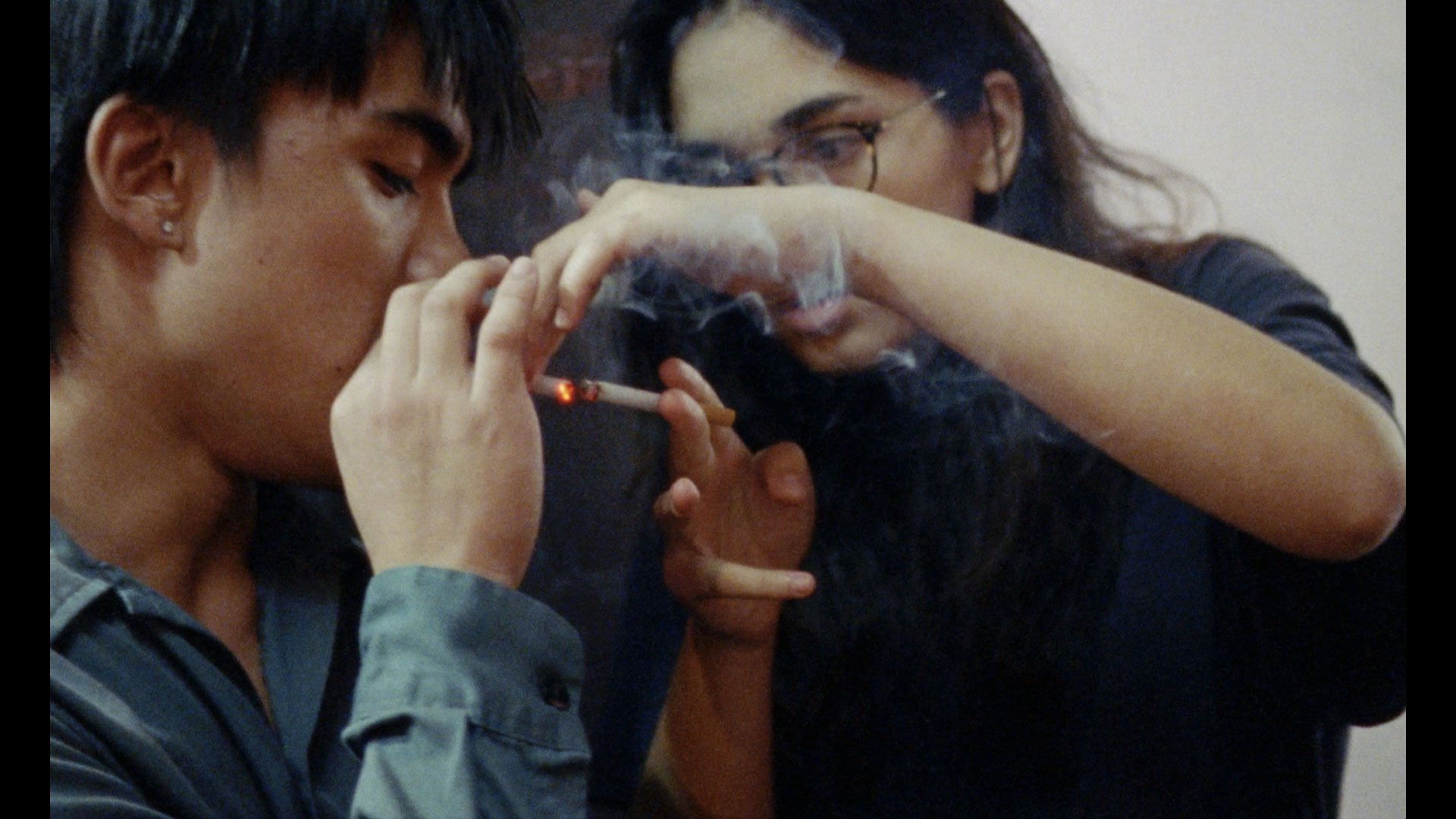
Does he smoke cigarettes? Because he smokes them so fast and just tears through them in the scene.
JM: Uh huh, those two are fucking chain smokers. They're pretty young, too, but they smoke like chimneys, both of them. I don't smoke, but then after long days I’m like, “I’m having a cigarette.” I feel bad, I'm like, “am I encouraging or enabling this?”
I'm sure they wouldn't mind a couple extra takes, getting a couple extra cigarettes.
JM: That’s what was happening.
Thank you, I mean, what a terrific movie. I'm so impressed by directors that can dominate instant intimacy, and you really do have that. It's a shooting style, but it's also your voice, it's that instant intimacy. It's very impressive to have done it right out of college, I can't even believe it.
JM: Thank you so much.
If you enjoyed this article, please consider becoming a patron of Hyperreal Film Journal for as low as $3 a month!
Hello! My name is Eli and I am a film fanatic based out of Houston, Texas. I am currently working on becoming a filmmaker, while also working full time. Film is my hyper fixation turned passion. I simply adore the flicks! I love learning about the history of cinema and seeing how that history shapes what we watch today.
I talk about movies on my Instagram: @notelifischer, TikTok: @loads.of.lemons, and Letterboxd: @Loads_of_Lemons