
HCAF ’25: Interview with Julian Castronovo on Debut
We sat down to talk to Julian Castronovo, the star, writer, and director of the film Debut, or, Objects of the Field of Debris as Currently Catalogued. One of the most standout and spectacular films I have seen this year, perhaps even in the last decade. It tells the story of a young filmmaker, Julian Castronovo, as he discovers a trail of clues related to the disappearance of a skilled art forger known as Fawn Ma. In this interview we talk about duplicity of images, finding new avenues for genre presentation, and Subway Surfers footage that is absent of Young Sheldon clips.
The film screened at the Houston Cinema Arts Festival as one of the many stops along its festival run. It will also be returning to Texas for a screening in Austin this upcoming January.
The following conversation has been edited for length and clarity.
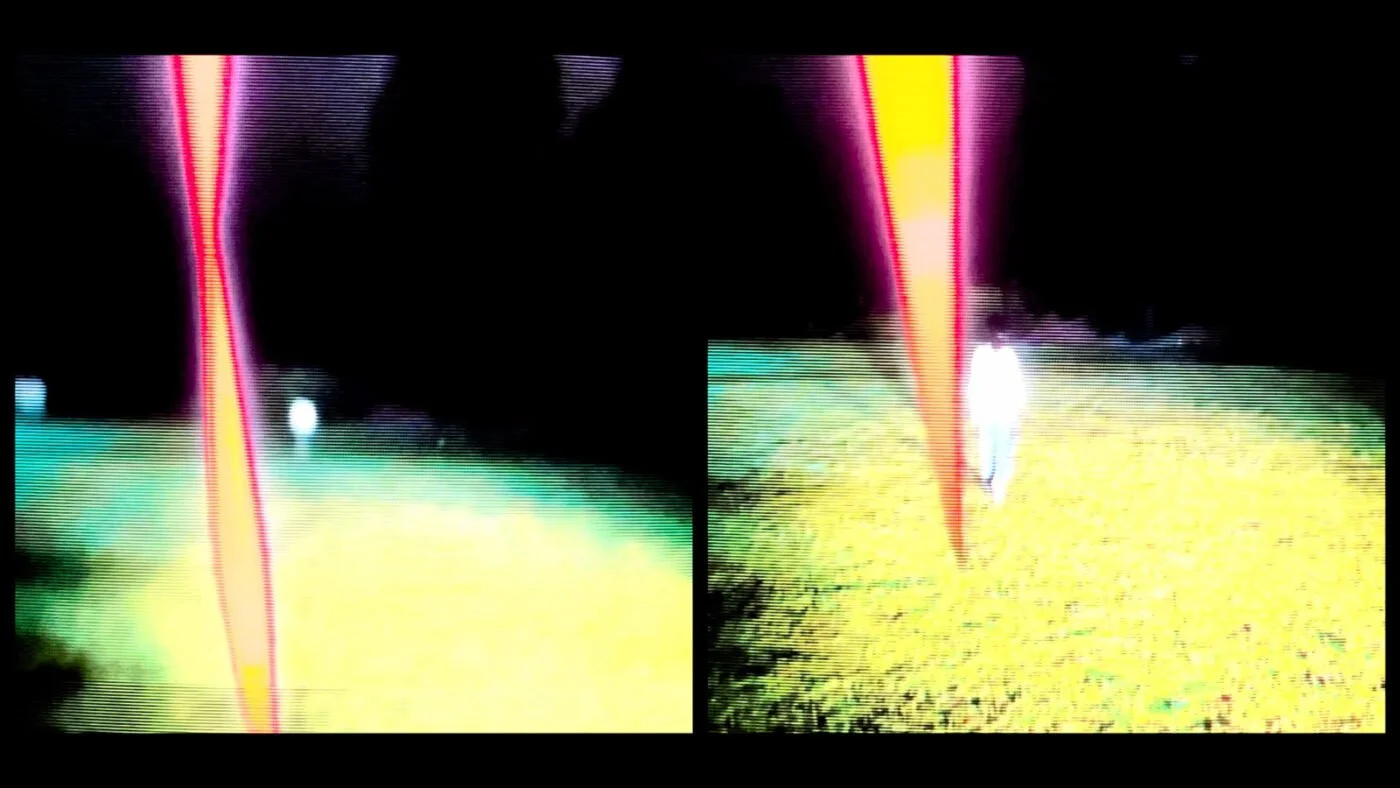
So I am always interested in, especially as a writer-director, did you have a North Star image? This idea of an image that persists throughout the entire process or something that you wanted to chase?
Julian Castronovo: I don't know that I had an image that I was after. I was chasing the idea that cinema itself could offer me a set of tools for making my own life meaningful, and for making myself into someone slightly different. A person who is perhaps slightly different for myself, [who] would be capable of overcoming some of my own limitations.
It reminded me a lot of a movie, F for Fake by Orson Welles. The whole thesis of that film is kind of art forgery just as valuable as original art. Did you find that to be like a persistent thesis for this film or did you like that idea of forgery being as much of an art?
JC: I don't know that I think of it like that. I think the artwork I made within the film as this other person is both a forgery and it's not. I'm working from a place that isn't myself, so to speak, but it's a character that I've invented. So, it's kind of a double invention, or it's doubly deceptive in a way that I'm not sure if it becomes sincere.
Do you find that you worry about audiences buying in? Like, as an audience, you walk into a theater and you sign a contract, right? Do you think about that idea of deceiving the audience, but also them buying into the deception?
JC: Yeah, I think that as I was making it and as I was coming up with the concepts, I knew very early on that I didn't want to trick the audience. The audience should be in on the trick, I think. It's like a half-hearted trick. I think the film is full of contradictions. It’s full of contradictions in a way, but it was never my intention to convince people that the story was real. I feel that's just a less effective thing or a less interesting operation than something else.
The audience is buying into the investigation, the story, it's not necessarily buying into the deception of the story.
JC: Yeah, or I think that I wanted the audience to know that real things and fake things would be placed alongside one another or intertwined. I hoped that people would stop caring about what was real and what was fake.
Because you're presenting it with a narrator, right? That's how we open it, and the narrator is presenting it as a matter of fact. How was that process of finding that blend of those things that you're creating and the things that you find?
JC: The idea of finding versus creating is perhaps the most interesting part of the film. The film itself began to generate its own evidence that I was using in the film. The fiction began to generate the evidence that the film was built on. The example I like to give is that the character, Julian Castronovo, has to go to Prague and walk across the field and leave his footprint in the mud. And because he has to do that, then, of course, I had to go do it. Because fictional Julian Castronovo flies to Prague, Julian Castronovo’s ticket from LAX to Prague is a real plane ticket, you know what I mean? The fiction began to beget that material evidence.
What I’ve always found interesting about films, and I don't know if you agree, but I don't think there's such a thing as an honest movie, right? Even the stuff that presents itself as honesty or true stories, everything has takes, you know? Do you think you wanted to present this as an honest movie?
JC: I think maybe I would say almost the opposite of what you said, in that all movies are honest documents of artifice or of lies. Even if you have a perfect sound stage where you're filming this thing that completely draws you in and has no inaccuracies, the movie itself will always be a nonfictional document of that pretending. It's always a true picture of something false. I don't know that I could place it in one way or the other, but that's what's compelling about the form to me.
That’s probably not even your job to place this movie as honest or fictitious
JC: I like to think of the heart of the movie as being sincere and being honest even as it traverses all these petty deceptions and tricks.
I like that you mentioned the artifice of it, because artifice with low budget is harder, and I think it's something that people stray away from, but your movie finds a way to embrace the artifice of it. What was it like cultivating that artifice for this film in particular?
JC: I don't know, I didn't have a logic to the way that I would do things. I liked everything that's included in the film to have a purpose for being there, even if it's a petty one. For example, I have a Subway Surfers thing in there. I felt that I needed to include that, because I had already been editing and I had been interested in having two things play at once on the screen. The brainrot tradition is that when there's two things on the screen, oftentimes one of them is Subway Surfers and another one is something else. I wanted to put that in because I already had that operation of two images at once. I was like, “but what if the Subway Surfers thing is there on its own?”
That really threw me, I was like, “this is supposed to be playing underneath a young Sheldon clip or something.”
JC: I don't know, I think, in a way, it was what it means to experience the world as there's these constant dreams of slop and images. As a person you try to look at it and some of it is perhaps meaningful or obscene or whatever and it's all mixed together. I felt that, in a way, ran parallel to the experience or a detective narrative where it's like the detective has to move through the world, and identify the things that are meaningful among a field of things that are not.
I wanted to talk about this idea of the FBI investigators. You think of investigators as finding cold heart facts, right? However, when they start to analyze something like artwork, and then they have to look for aesthetic quality and everything, did you find that to be a persistent theme throughout the film as the Julian Castronovo character starts to investigate – that idea of expertise through investigation?
JC: I think of the film as a push and pull between a desire to be cold and analytical and a desire to be moved and be emotional and to connect to the things that we study, even if we're trying to study them in an objective way.
I don't know how much of the process was malleable for you, you mentioned in the Q&A right now of waking up every day and treating film like an art. Did you find the movie to be malleable because that was your approach or was it malleable just because movies are malleable?
JC: Both. I had planned or anticipated making certain types of images and then tried them and didn't like them. So, I did other stuff, and then I liked how certain character aspects and things were transformed or changed over time. I had originally conceived that this character was supposed to be a Humphrey Bogart, Marlowe type of character who would be all these things that I wasn't. Super confident, quick witted, and discerning. This classic private eye. Then as I was making the movie, I realized that my character would be more interesting if I could use it as a vessel or a confessional tool to reflect my own feelings about making the movie, which were feelings of uncertainty, unease, and anxiety. At a certain point that character I'm playing changes from this, Bogart private eye into something that was much closer to my own experience as a filmmaker who's making that film.
I love genre movies. I like them because the audience is fluent in the genre, even if they don't know that. You watch Humphrey Bogart in a noir film and you kind of expect the beats that are going to happen. Then as you start to get into this movie, you start to find those same genre stylings. Was that a super intentional thing of speaking in genre?
JC: Yeah, I mean, one of the most intentional or important things to me was using the tropes of genre and of detective narratives. It helps to give the film a spine, I think, and at the same time, it's also an intellectual thing or was related to the content of the film. I felt I had gone to school, and I'd been trained to think in a certain way. A sort of a structuralist or theoretical way, which involves assuming or understanding that the world around you has a subterranean level of meaning. If you look at an advertisement, television, a book, or whatever, you can look at it and read into it and there's meaning beneath that. I felt that the most potent distillation of that type of thinking was the logic of a detective. You can find something and treat it as a clue, and when you know how to decode it properly, it will point you in the direction you're supposed to go. At the same time, it was also a purely narrative move. I had kind of known I wanted to experiment in this way aesthetically and formally, and I think that I knew that I could only get away with those things if I was rigorous about telling a story in a straightforward way. As much as detective stories often spiral and go in different directions, they always have a very linear version of events or narrative motion and momentum. You find a clue and solve the clue and it leads you straight ahead to the next thing. So, it was important for me to have that linear thing. I felt that audiences-- and myself as a viewer-- need a thing to grab onto in order to accept other types of less traditional modes of image making.
So do you think you feel that your movie works as a subversion of those genre tropes? Maybe not even in the story structure, but I guess maybe in the presentation?
JC: I don't know that I was trying to subvert genre tropes. I felt I was trying to use them, maybe that's the same thing. Maybe the ending becomes subversive. I would think that what “subverting genre tropes” means is like, “okay, audiences have been conditioned by genre to expect a thing, and then it doesn't happen.” So maybe that happens towards the end of the film, but I was more interested, I think, in fulfilling the expectations, for the most part, as a way of making my movie coherent, and then allowing incoherence in other areas.
I'm very interested in the score, it’s very persistent and constant. What was it like finding the sound of the film?
JC: My friend Jules Becker made a bunch of the sounds, especially the synth stuff. Some of the sounds are little snippets from early 12-tone music or atonal music. I liked how that felt, and then there was a practical reason where it was easy to pitch it up and down and to move individual notes around in the edit in a way that people wouldn't notice; in a way that could serve the rhythm of the film. I don't know, I think that I think about sound last.
Really? Do you find sound to be impactful for you in the films you watch?
JC: Yeah, of course, I think that I was banned from cutting to music. This is the first film that I’ve made where I've ever used music. I think that's a good way to learn and a good way to be. I think, largely, people are too reliant on music and sound design. I think that you should be able to establish rhythm without those things, or you should establish that and then add it last. So, maybe that's why I added it last.
The beat should be there without needing to rely on music.
JC: You don't want to use it as an emotional crutch where it's telling you what to feel. I think you should be able to achieve those things, whatever, through the images and through the writing. So, I don't know, the way I think about the sound of my film it’s kind of a satirical relationship with certain tropes of noir and detective films.
When you were conceiving it, did you find it to be very satirical, the method of creating the film? Because from talking to you right now, it doesn't sound like there was an intention to be satirical.
JC: Maybe satirical is the wrong word. I want it to be playful.
I know you talked about the double images. I mean, that's the first image of the film. It splits off into a double fracture. Do you interpret that more as playing into the idea of the forgeries or playing into the idea of this duplicity of making a movie, while you’re in the movie?
JC: Yeah, I mean, both.
If you enjoyed this article, please consider becoming a patron of Hyperreal Film Journal for as low as $3 a month!
Hello! My name is Eli and I am a film fanatic based out of Houston, Texas. I am currently working on becoming a filmmaker, while also working full time. Film is my hyper fixation turned passion. I simply adore the flicks! I love learning about the history of cinema and seeing how that history shapes what we watch today.
I talk about movies on my Instagram: @notelifischer, TikTok: @loads.of.lemons, and Letterboxd: @Loads_of_Lemons