
Disclosure Day: Steven Spielberg Still Wants to Believe in Humanity
When watching Disclosure Day, it’s difficult to forget you’re in the hands of Steven Spielberg. This might seem like an obvious statement, but for a filmmaker synonymous with blockbuster movies, Spielberg has rarely, if ever, made something impersonal in his 50 year career. And Disclosure Day is perhaps the most personal blockbuster he’s made in 20 years. Over the course of the runtime, Spielberg is placing all his ideas on the table; not only its bravura style, but in the ways he’s able to synthesize the old pleasures and the new. It’s about life from outer space, and yet, also about our relationship with God and the modern world, the traumas hidden inside us, and even the way Spielberg views himself. I was doubled over by it.
Surprisingly, Disclosure Day opens at a wrestling match. The very first image is of wrestler Lance Hoyt stomping the camera and swinging it around the ring. Immediately Spielberg is toying with the viewer, making one question if they’ve walked into the wrong movie. But don’t worry, the camera quickly pushes in on Daniel Keller (Josh O’Connor)—and he isn’t here for the match. Daniel is a cybersecurity specialist who’s stolen valuable tech and information from his job at Wardex, a secret arm of the U.S. government, run by the determined Noah Scanlon (Colin Firth).
The corporation has drawn Daniel out by kidnapping his girlfriend Jane (Eve Hewson). It becomes apparent what Daniel is in possession of is alien in nature, and he uses this to his advantage, conducting a thrilling escape, the first of many, with both the tech and Jane. The couple on the run take refuge in a convent run by Sister Maura (Elizabeth Marvel), and it’s revealed Jane was at one point going to be a nun. In the funniest exchange of the movie, Daniel asks if it’s true she’s a nun, and she responds with a dry “We’ve had sex.”
The relationship between Daniel and Jane is cleverly written by David Koepp (Jurassic Park, Spider-Man), with a story credited to Spielberg. It’s refreshing to see a movie where the girlfriend character isn’t tossed off or viewed as an obstacle, and is bolstered with the wonderful performance by Hewson. Jane has her own fears and questions, independent from Daniel, who is also well performed by O’Connor; the two actors have real believable chemistry. But they aren’t the only ones on the run.
Kansas City meteorologist Margaret Fairchild (Emily Blunt) is getting ready for work when she suddenly develops the ability to fluently speak languages she doesn’t know. This rightfully freaks out her musician boyfriend Jackson (Wyatt Russel). Even stranger, she doesn’t realize she’s doing it. Then while presenting the weather, Margaret seemingly starts to have a stroke, resembling real viral videos in the past, except guttural clicks escape her mouth, causing Wardex to take notice.
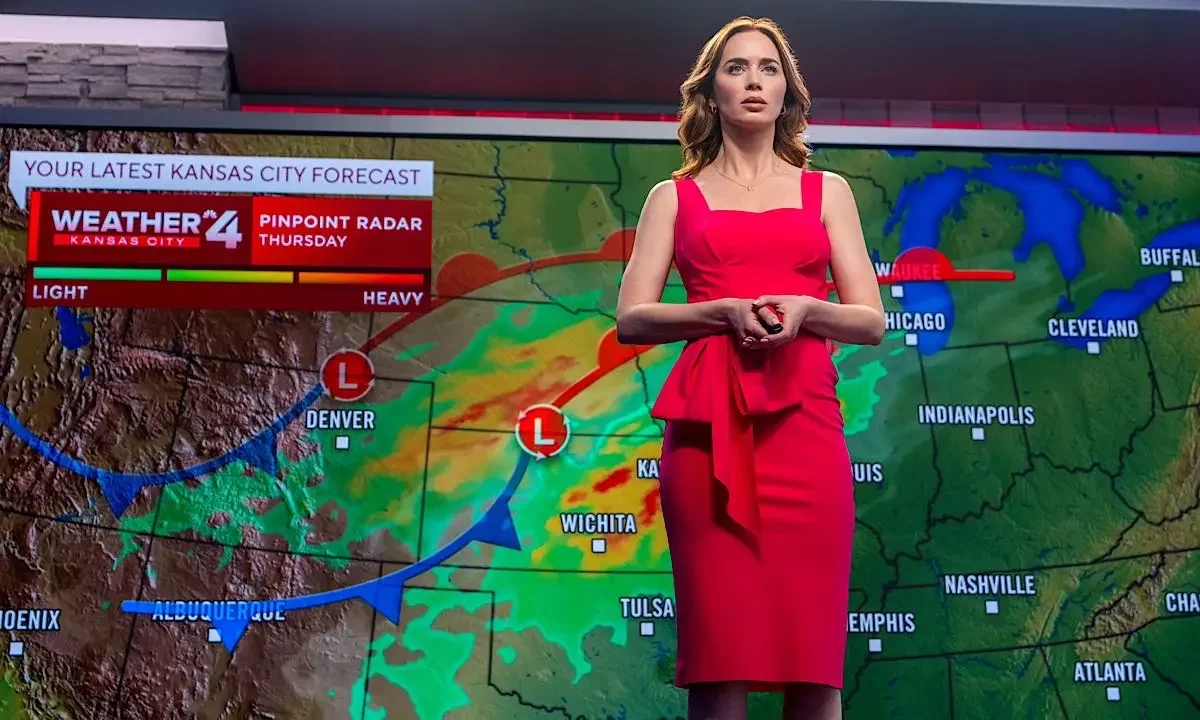
Spielberg and Koepp shoulder a risky structure that could cause even good filmmakers to flounder. None of the characters are privy to the whole picture. It’s a lot of scenes of people asking “What is going on?” In a lesser work, you’d become restless, feeling the hand of the filmmaker too much, just wanting to know what the hell is happening. At first, Daniel is the man with all the information and is insistent on going full disclosure about alien technology. However, he too learns that there are secrets about himself that he’s yet to fully comprehend. Smartly, the filmmakers waste little time and keep the train going while also knowing when to slow down, not allowing you to dwell on the information that has been selected.
Emily Blunt is a revelation in this role, her best performance since her action turn in 2014’s Edge of Tomorrow. Whenever the script gets a bit too obvious, she finds a way to make it work. I love the way the camera stays on her the first time she speaks Russian; the switch in languages is so smooth for a second you wonder if you’re misshearing her.
The film is filled with white-knuckle sequences, featuring dazzling camerawork by Janusz Kamiński, a long time collaborator with Spielberg. In a standout move, the camera follows Daniel sneaking around Wardex agents, whipping circularly around a fence, and not concluding until the camera gets into the passenger seat of a stolen car. The brilliance is the way Kamiński several times switches positions in fluid motion, without ever breaking the immersion or tension. Spielberg rejects the notion of the “one perfect shot,” showcasing that the best cinematography is about motion and the placement of the actors, not overly manicured stills.
The film also has a nice, steely grey color palette evoking a kind of futurism, making the story feel like it’s taking place a few years ahead while still recognizable. It also recalls the tone of 2002’s Minority Report, another Spielberg work revolving around conspiracy and characters on the run. Nevertheless, there is an old-fashioned quality to Disclosure Day that is hard to describe. It’s as if Spielberg came across a script written in the heyday of All The President’s Men and The China Syndrome (Blunt plays a Jane Fonda-type character, in that her beauty distracts people from her sophistication), and simply updated the technology. Firth isn’t doing an impression of one of our modern day villains. He’s smooth, but direct in the way he speaks, ideologically focused, only allowing a few precious flareups.
To some, certain sections might come across as outdated. The final act requires you to believe millions would still be glued to a TV news station and without getting too spoilery, the film barely touches on AI image generation and how low the trust is in legacy media. After all Spielberg is turning 80 in a few months, and even when he was directing Jaws at 26, a fact that makes me shutter, he’d hardly be called hip. But, the filmmaking prowess carried me along and found the old-timey touches enduring. You get the sense this is the only way Spielberg could’ve told this story.
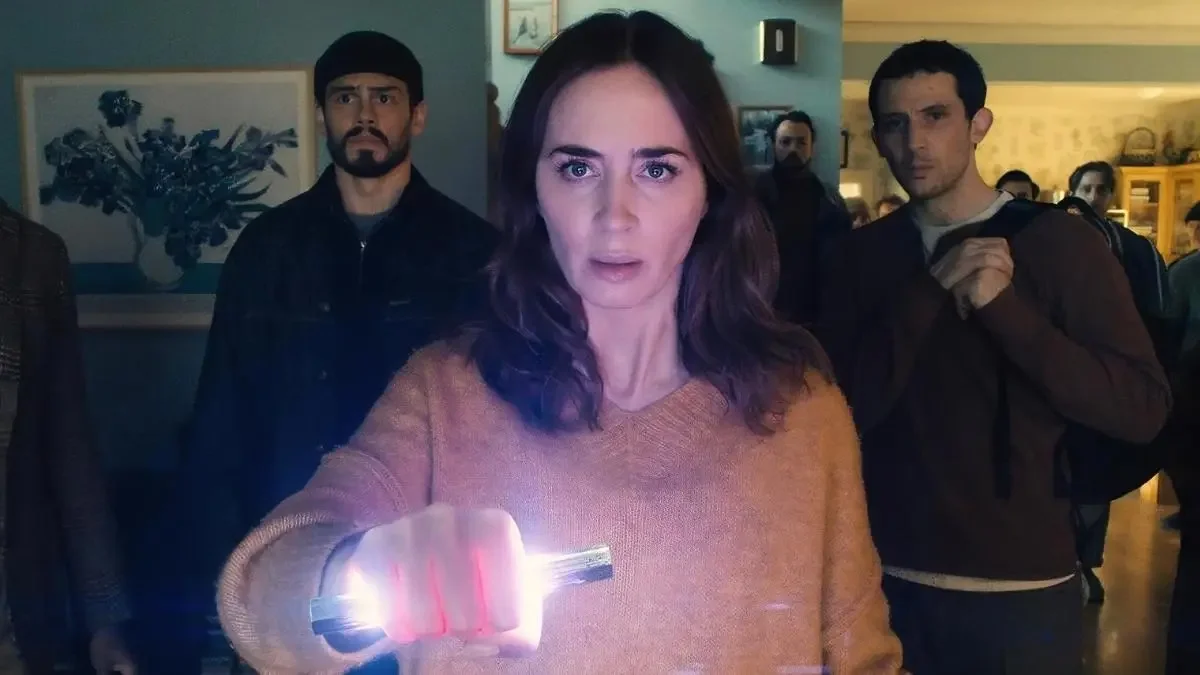
And despite his undisputed filmmaking prowess, spirituality has never been a part of the tool box. Religion plays a part in Raiders of the Lost Ark and The Color Purple, but not to this extent. By virtue of almost being a nun, Jane is deeply concerned how the revelation of aliens would affect her relationship with God. Does their existence negate what she believes, or simply an extension of it? Importantly, however, Margaret goes through a spiritual experience, realizing she contains a power that isn’t entirely in her control, which frightens her. She doesn’t feel blessed, and later screams “I don’t want to be your religion!” The character is reminiscent of Sammy Fabelman from The Fabelmans, ostensibly Spielberg’s fictionalized autobiography. In that film, Sammy fails to explain where his talent comes from. He just knows where to place the camera, similar to how Margaret can without missing a beat can use her abilities. Now, I hardly believe Spielberg views himself as a messiah. But he does relate to this heady idea of natural ability, something so many artists wish they had access to.
The running threat of World War III permeates the story. It’s a little bit underbaked for my tastes as it never goes outside of generalities(lots of mentions of North Korea), but in the context of the film, it works as a stand-in for our current troubled world. It’s a good contrast to the reasons why Scanlon wants to prevent the titular disclosure day. In his eyes, the revelation of aliens would throw the world into even greater chaos and instability. The final act is Spielberg pleading against this. At the end of Close Encounters of Third Kind, the main character Roy enters the spaceship and leaves his family behind, a decision Spielberg regrets. Disclosure Day is a correction nearly 50 years in the making. Instead of humans entering the cosmos, the cosmos comes down to us, in hope that the realization that a world exists outside of our own can cause serious reflection. And maybe, just maybe, that will inspire us to stop the brutality against our fellow man, against our home, as it’s the only one we have.
If you enjoyed this article, please consider becoming a patron of Hyperreal Film Journal for as low as $3 a month!
Hayden Claborn is a film writer based in Austin, TX. He began writing about cinema in high school and was the film critic for his college newspaper. He loves a variety of genres, but his main area of interest is horror films and can talk your ear off about the greatness of Judy Garland. Depending on what day you ask, he’d say his favorite movie is either The Exorcist or The Apartment, with his favorite filmmakers being James Cameron and David Lynch. He goes by He/They pronouns.