
Barrio Triste Review: Los Hijos de la Luz
The debut feature from Matías Vásquez, better known as Stillz, Barrio Triste is a fascinating mix of pungent social realism and brain-frying surrealism. Set in the 1980s, the film takes its title from a real settlement in the hills outside Medellin, Colombia, officially named Barrio Sagrado Corazón. (It was actually filmed in nearby Robledo Paraíso).
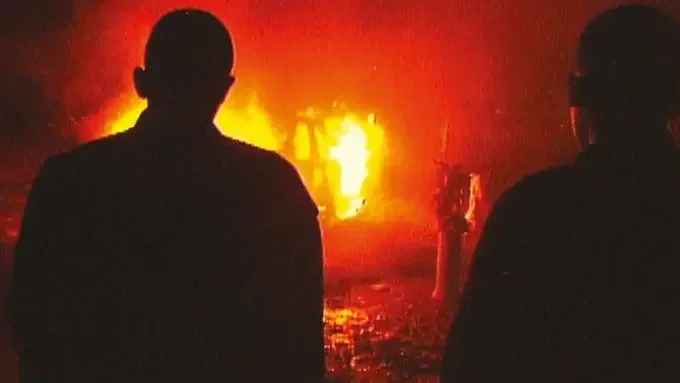
The film opens from the shaky POV of a news camera. As the anchor delivers his report on UFO sightings in the area, a group of teenage punks loitering in the background suddenly spring into action. The camera view tumbles into chaos as the punks make off with it. As they ponder what to do with their acquisition, one comments, “Even if we bought it, they’d think we stole it.” Instead of pawning it, they decide to document whatever they do next.
The film sticks with the lo-fi visual conceit throughout. According to producer Eric Kohn, Stillz shot the entire film using a vintage 1980s Panasonic TV camera. “It was a beast…but we didn't use any real tapes. The camera was plugged into a monitor and we recorded the footage directly into a hard drive.” The process provided the best of both worlds: period-accurate retro imagery and modern digital flexibility.
The first act hints at a dynamic found footage thriller, as the youths don creepy masks and brandish pistols in a stolen car. In a remarkable long take, they make their way into Medellin’s city center while the car stereo drones a news interview with a serial killer confessing matter-of-factly to a string of murders. The long take continues uninterrupted as the young crooks jump out of the car, robbing a jewelry store as the soundtrack blasts malevolent noise. Special mention should be made of Arca’s overwhelming score, which also encompasses celestial tones, sampled acoustic guitar laments, and a wide spectrum of digital textures.
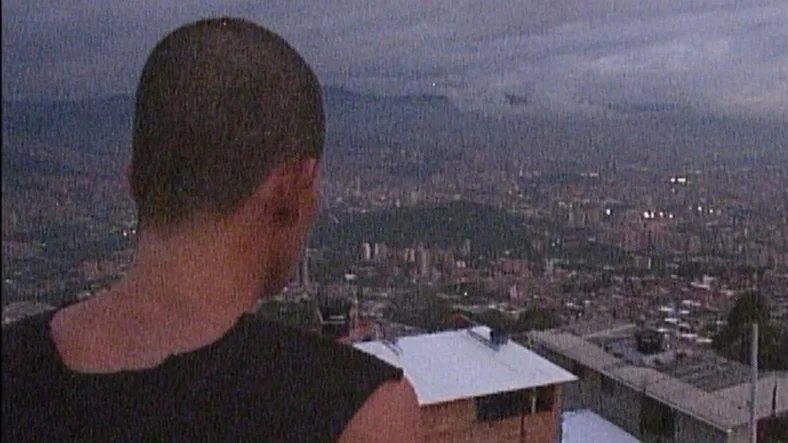
After this lone action scene, the film settles into a more vibe-driven narrative. No detectives appear to hunt down the bank robbing crew. The setup of missing persons (desaparecidos) takes a much stranger turn than the anticipated serial killer whodunit. Instead, we get horses living in bedrooms and punk bands rocking in the rusted-out ruins to an audience of no one. Random characters simply go about their business, like the kindly old man with a young child in one hand and a chainsaw in the other.
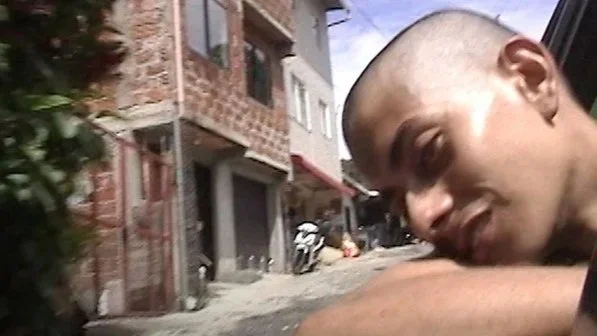
The young cast brings remarkable verisimilitude to the screen, rocking paper clip earrings, stick and poke tattoos, and real-looking scars and scabs. Kohn notes, “We befriended an entire community, Robledo Paraíso, and collaborated on building this world. We used an incredible casting director who had been part of the City of God team to do the bulk of the street casting, and held acting workshops so everyone felt prepared.”
Stillz captures the unique mix of desperation and dreaminess as the young characters roam half finished buildings, dodging naked rebar spiking out of bare concrete and balancing on sheer 30-foot dropoffs. As one mentions, “We wanted to believe in something, but we got our asses kicked.” Kohn notes, “Stillz did many, many long takes of the same walking passages — very little about this movie was improvised in terms of camera movement, so it was important we had a clear sense of which environments he could explore.”
As the eventful day turns to night, the film delivers visually arresting cityscapes of Medellin from the hilltops. The film’s third act segues into evil surrealism, introducing nightmare images of maze-like corridors, towering monsters, blood and disembowelment. A party scene involves heaving huge rocks and empty liquor bottles at a burning Mercedes. A youth kicks headlights off cars, one after another, crunching in the otherwise silent night. Later, the gang go swimming in a fetid pool in what appears to be an abandoned luxury hotel construction site.
This is all very on-brand for the trash-transcendentalist aesthetic of executive producer Harmony Korine (Gummo, Aggro Dr1ft). But Stillz’ haunting work is less concerned with provocation than the psychic extremities of its subject subculture, especially in its horror-adjacent third act. Kohn explains that Stillz connected with Korine through the skater scene in Miami. “ [Stillz] and Harmony cooked up the basics of the kids-with-a-stolen-camera idea. Then Stillz returned to Colombia for the first time in many years, and did charity work in Barrio Triste, realizing through that process that he wanted to inject the movie with his own personal interests.”
The result is remarkably original, creative, and heartfelt, one of the best films of the year. “We are rough boys,” a character admits, but, as a spray of graffiti announces in one of the film’s many labyrinthine tracking shots, they are also hijos de la luz–children of light.
If you enjoyed this article, please consider becoming a patron of Hyperreal Film Journal for as low as $3 a month!
Matthew K. Seidel is a writer and musician living in Austin since 2004. The above selfie was taken in an otherwise empty screening of Heat at 10:30 in the morning. You can find him on Letterboxd @tropesmoker.