
Northwest Austin Had the Movie Theatres: A History of the Arbor Cinema(s)
Northwest Austin was never the most acclaimed part of town in terms of arts entertainment when I was growing up. Though Austin was already famous for its sheer number of music venues, officially dubbed as the “Live Music Capital of the World” by the Austin City Council in 1991, Northwest Austin in the 1980s/1990s maintained a chill vibe when it came to crowd-gathering events. For example, the long-running free concert series “Blues on the Green” did begin at The Arboretum in 1990, in the hopes of boosting shopping traffic, but it moved to Zilker Park in 1999. Back then, Northwest Austin was the edge of the Austin Metropolis, an upper middle class environment that catered more to families than to the hippies you would find more regularly elsewhere. But one artistic highlight that the Northwest Austin-of-my-youth could claim: we had the movie theatres; specifically, the original Arbor Cinema and, later, Regal Arbor.
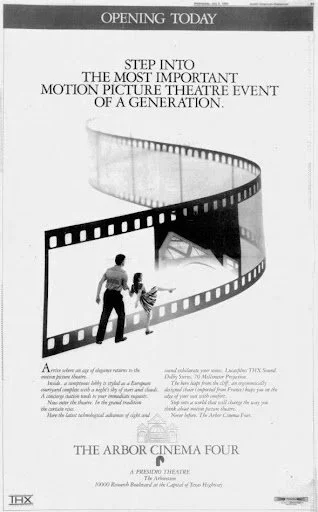
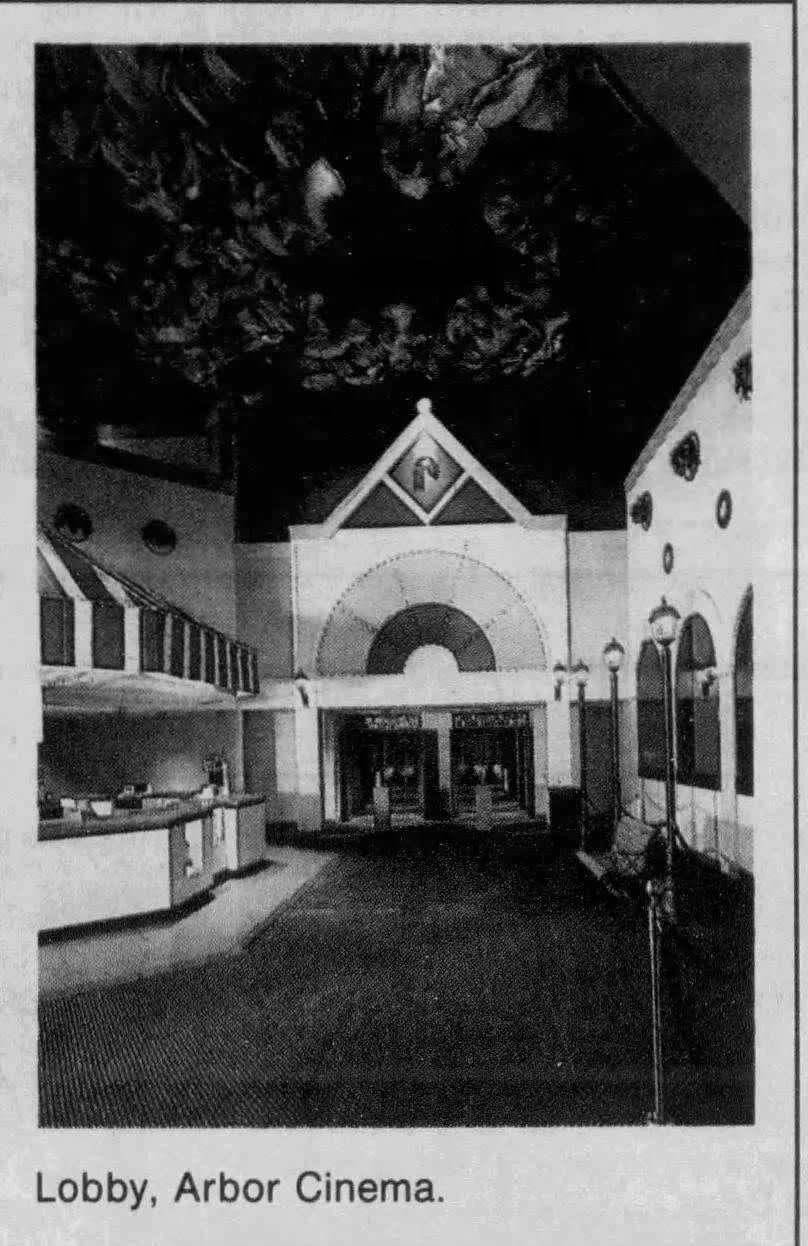
Presidio Theatres debuted the original Arbor Cinema on July 3rd, 1985. In its full page newspaper ad, Arbor Cinema welcomed patrons to “Arrive where an age of elegance returns to the motion picture theatre.” Its exterior poster cases were outlined in white-colored brick with a large “P” engraved above each case. Its famous interior featured a large lobby, with restrooms on the second floor, and a balcony that overlooked the lobby. A circular staircase and an elevator styled like a clock tower allowed access to the second floor. How appropriate that the Arbor screened Back to the Future (1985) for both its opening and the film’s premiere weekend! The lobby ceiling was fashioned with clouds and stars that featured their own sound and light effects, suggesting thunder and lightning. Walking into Arbor Cinema was like walking into a “European courtyard” during a raging thunderstorm! It was truly a magical atmosphere that transported patrons into a different world right before they attended their selected movie. Its theaters featured slightly elevated seating with, at the time, the most comfortable seats of its era that were red velvet, plush, and included retractable arm rests. Arbor Cinema was also THX-certified to ensure the best quality sound for patrons to enjoy the movies. It originally opened with four theatres in 1985, but expanded to seven screens in 1990.
My nostalgic memories of the original Arbor Cinema are of specific screenings: seeing The Endless Summer II (1994) with my family as part of my mother’s annual, day-long birthday celebrations; falling asleep and waking up alone in the theater during Buena Vista Social Club (1999); catching Crouching Tiger, Hidden Dragon (2000), one of my first martial arts movies to enjoy; a rather “romantic” viewing of The Man Who Wasn’t There (2001) with my high school girlfriend; and Amélie (2001), the last film I would ever see there. The Arbor was known for its first-run, independent and international film programming. I am unsure if its programming was as such during its entire seventeen-year run. From the comments at movie fan site https://cinematreasures.org, I presume it wasn’t always the case. But I appreciate the era when I enjoyed the Arbor the most – when I was of driving age and going to see movies on my own. This was a time when I was investigating newly-released movies more deeply, especially of independent and international variety. Catching movies at the Arbor was immensely influential on my own personal film aesthetic, as I am still drawn to movies of those flavors. Arbor Cinema closed in March 2002. It has been a Cheesecake Factory ever since. While the food is good, I have rarely dined there, as I would have preferred for Arbor Cinema to exist in perpetuity.
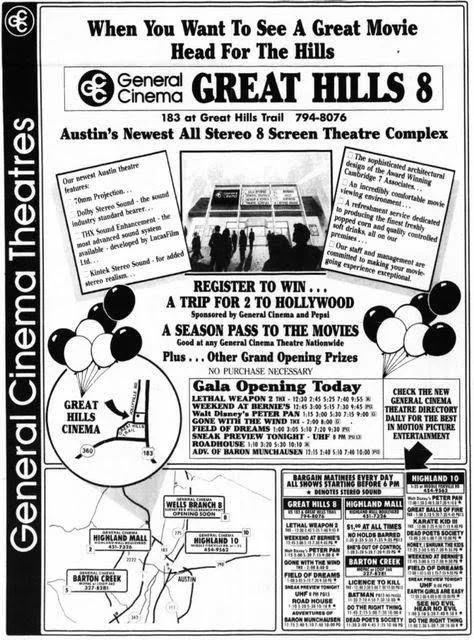
General Cinema Theatres opened Great Hills 8 on July 14th, 1989, just minutes away from the Arbor. Its entrance faced Jollyville Road, and it had a magnificent oak tree out front, providing shade to those who waited outside. My older brother worked for Great Hills 8 one summer; I can still remember his maroon and navy blue uniform polo. The programming at Great Hills 8 was of a mixture – first-run movies, but not necessarily the hits. I remember catching Highlander: Endgame (2000) there. I bought a ticket to a different movie and then sneaked into Highlander because I wasn’t old enough to purchase admission to an R-rated movie. Additionally, I recall how an older male patron teared up when Duncan MacLeod (Adrian Paul) had to kill his kinsman Connor MacLeod (Christopher Lambert). Listen, I enjoy the Highlander franchise, but none of the films are tearjerkers. I suppose “there can be only one” crying patron…
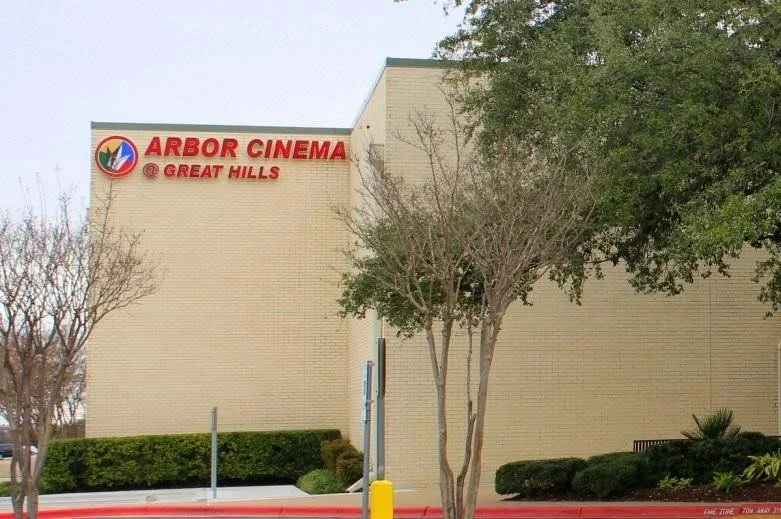
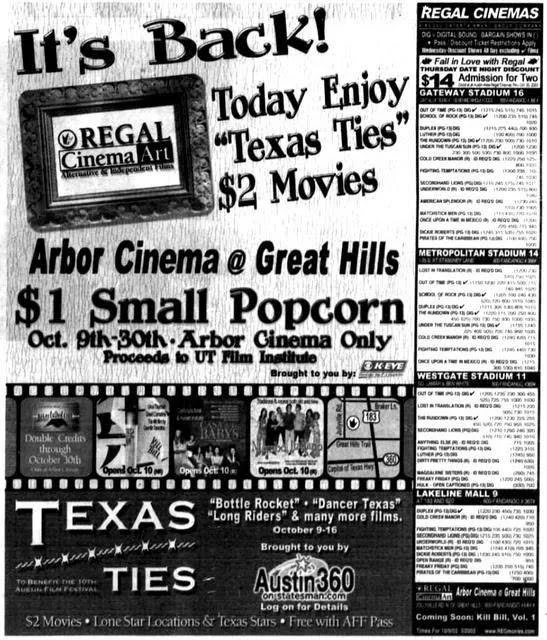
Great Hills 8 closed in 2000. Although Great Hills and the Arbor closed within a couple of years of each other while I was in high school, it didn’t quite feel like an end of an era as Act III Theatres opened Gateway 16 across Highway 183 in 1997. However, the loss of arthouse programming was definitely missed by serious moviegoers. There was great rejoicing when several years later, Great Hills 8 reopened as the new Arbor Cinema by Regal Theatres in October 2003, specifically providing first-run independent and international film programming. Long-time patrons of the original Arbor missed arthouse films that, at the time, were not commonly found in Austin except for the famed Dobie Theatre at UT Campus and the original Alamo Drafthouse Cinema on Colorado Street (Austin’s warehouse district) which specialized in cult programming.
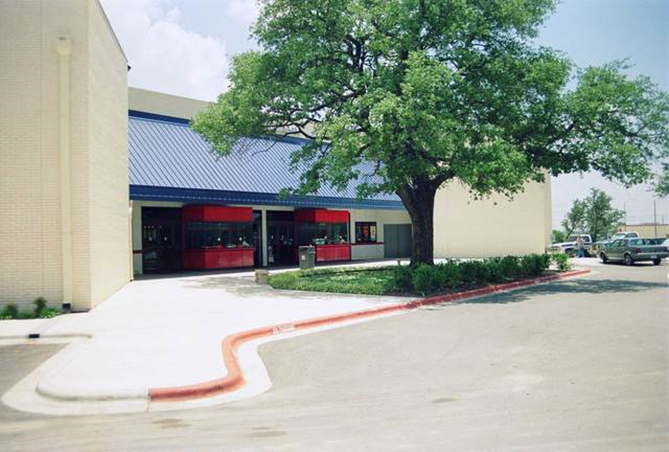
It would be several years before I would truly enjoy Regal Arbor, as I was out-of-town, away at college. Upon my return to Austin, I immediately began catching movies there, quite regularly until its eventual closing in 2022. Over that timespan (16+ years), I caught dozens of films there each year. Several of the more memorable included Hot Fuzz (2007), There Will Be Blood (2007), Revanche (2008), The Grand Budapest Hotel (2014), The Death of Stalin (2017), and Arctic (2018). These films stand out more prominently in my mind as I saw them with either family members or friends, which is always the point of the movie theatre experience, to enjoy narratives in a communal environment. Another unforgettable experience at Regal Arbor included meeting Ethan Hawke when he presented his directorial debut Blaze (2018).
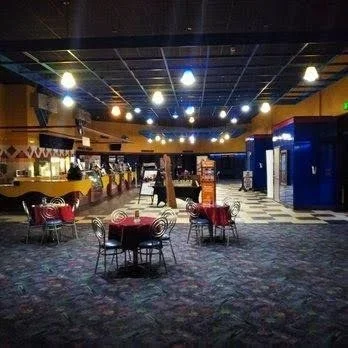
Regal Arbor’s lobby was not particularly amazing because its ceilings were too low for storm clouds and the restrooms were at ground level (its only level). Yet, Regal Arbor did try to make it chic by stationing tables on both sides of the building for patrons to sit while they waited for their movie theater to open. The chairs had a circling iron back design and people could read of forthcoming releases underneath the clear plastic tabletop. Its concessions were expansive, offering a wide array of beverages including alcohol they prominently displayed, with the beer always on ice.
Regal Arbor survived the global pandemic, but not by much. It closed in 2022, due to Regal/Cineworld’s bankruptcy. The last movies I saw at Regal Arbor were Vengeance (2022) and The Duke (2022). By then, Regal Arbor was in dire need of a sound upgrade because hearing the films’ dialogue took some effort. The building itself was demolished in 2024. Thankfully, the magnificent oak tree was left untouched.
The passing of the original Arbor Cinema and Regal Arbor is much like the narrative of Austin itself. Several great, artistic institutions are now gone; all of them had an unfortunately short shelf life. But in those moments, filmgoers had wonderful memories, perhaps like Rutger Hauer’s famed “Tears in Rain” soliloquy from Blade Runner (1982). Thankfully, as some movie theatres close, others open. Violet Crown Cinema debuted in 2011; Austin Film Society presented AFS Cinema in 2017; Hyperreal Film Club created its own microcinema in September 2024. Sure, I have to drive a little further now to catch quality movie programming, to other neighborhoods other than the area that I grew up in. But that synergy between film theatres and patrons remains strong in Austin, attempting to continue and elevate the movie-going experience.
If you enjoyed this article, please consider becoming a patron of Hyperreal Film Journal for as low as $3 a month!
Paul Feinstein is an arts professional who has produced content in different mediums including film screenings, live music, radio, and theater. He is a native Austinite.