
AFF '25: Wake Up Dead Man - A Knives Out Mystery
Benoit Blanc (Daniel Craig) is back as the iconic, deeply Southern, master detective for the third installment of the Knives Out Franchise in writer/director Rian Johnson’s Wake Up Dead Man, but this time, something feels different. Wake Up Dead Man is tonally much darker than the previous two installments, which were also comedic who-dunits with star studded casts. In this film, Rian seems to be wrestling with something much more personal at the heart of this gothic, twisty, and often hilarious mystery—his own relationship with religion. Make no mistake: Johnson’s writing is still sharp and he still manages to create delightful, satirical caricatures of potential suspects that meet the political and cultural moment. But Wake Up Dead Man feels like the first time that Rian is also telling us just as much about who he is as a person. It all makes for a much more brooding and introspective mystery where catching the culprit is just as important as the emotional journey that leads us there.
Despite being billed as another Benoit Blanc mystery, we don’t meet the famed detective until about halfway through the film. Instead, Wake Up Dead Man opens with a voiceover from Reverend Jud Duplenticy (cutie-pie Josh O’Connor), an idyllic, young Catholic priest who is sent to work at a remote church with a dwindling congregation. The church is a sinking ship and Jud is tasked with the unenviable task of trying to turn it around. The film’s exposition-heavy beginning focuses on Jud’s arrival at this new church and his rocky relationship with the Monsignor, Jefferson Wicks (Josh Brolin), the angry, domineering head priest who preaches mainly of fire and brimstone to his fiercely devoted but tiny congregation.
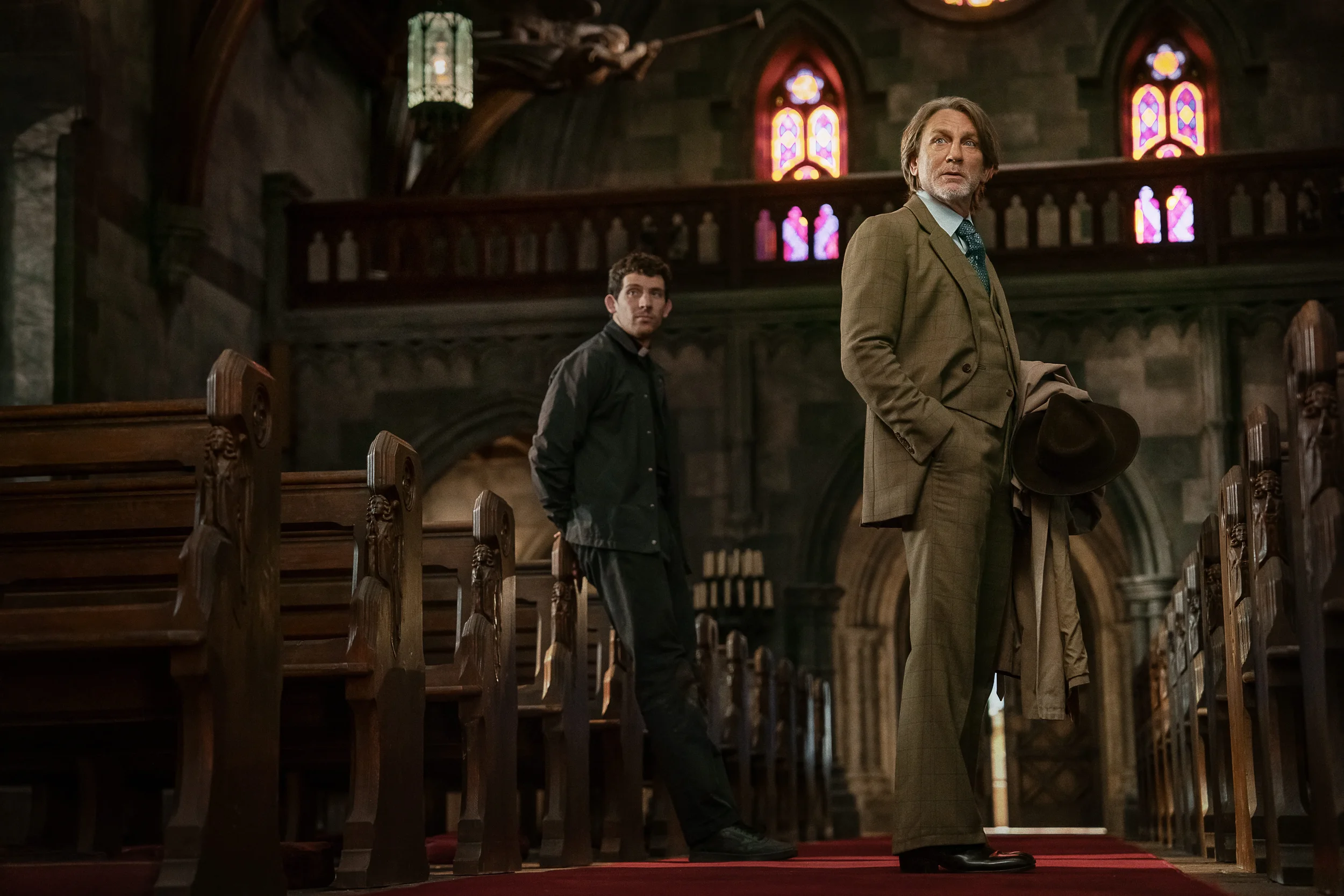
Wake Up Dead Man spends a lot of time painting the dark and foreboding picture of this failing gothic church and its unhappy yet loyal members. It’s clear Johnson has complicated feelings about the Christian denomination. During the post screening Q&A, he spoke about how growing up in a very Christian family—and eventually falling out of the faith—informed his writing of the script. So it makes sense that he spends so much time telling the audience about Wick’s sad congregation and all the hypocrisies that go along with a church that wants to actively antagonize its members who are just looking for something to believe in.
As Jud settles into his role as assistant priest, he consistently butts heads with Wicks as he tries to make changes to the church which would make it a more welcoming place to more people. Their tense relationship soon comes to an end after Wicks is mysteriously murdered during Sunday service. It is at this point in the movie when our beloved detective, Blanc, swoops in to attempt to save the day. After the murder, Blanc and Jud turn their attention to the faithful devotees of Wicks. This includes alcoholic town doctor Nat Sharp (Jeremy Renner), unfulfilled lawyer Vera Draven (Kerry Washington), cantankerous church lady and Wicks’ closest confidant Martha Delacroix (Glenn Close), failed right-wing politician Cy Draven (Daryl McCormack), and has-been author Lee Ross (Andrew Scott). Based on these short descriptions alone, it is easy to see that this sad bunch of folks are all primed to be potential suspects in Johnson’s twisty tale of murder and faltering faith. Johnson excels at writing these types of pathetic but compulsively watchable archetypes. They’re really funny in the way they consistently fail at being halfway decent people, and they all make for a fun bunch of suspects with their own unique motives for potentially killing Monsignor Wicks.

Since the first Knives Out, Johnson has expertly drawn audiences into his hyperbolic set-ups for seemingly unsolvable murders by creating worlds that are at once ridiculous and relatable. He is an astute observer of the world around him and understands how to translate that into effective characters with which to tell a compelling and timely mystery. He’s a master at this. With Glass Onion he successfully and hilariously tapped into the hyper elite world of a tech billionaire to tell his story, but this time he seems to be honing in on something much more personal—his own journey with faith. Sure, Johnson is not the first to grapple with religion with his art - far from it. Still, the story doesn’t feel trite or scolding like it could in a lesser auteur’s hands. It just feels natural. Johnson is working through his own history and comes out with a work that feels honest and thoughtful. By the end of the film, he makes no consensus on what religion should mean to him or his audience, it’s more of a meditation on many of the bad and good things that devout faith can bring out in people. Whereas Wicks’ character is a manifestation of some of the ugliest things that Christianity can be, it is countered by Jud’s genuine belief that the church can be a good place if we want it to be. The conversation between these two characters, as well as with confirmed atheist, Blanc, demonstrate the internal struggle many people who grew up in the church wrestle with.
With Wake Up Dead Man, Rian Johnson once again delivers a compelling mystery with a strong cast of colorful characters. It engrosses and entertains just as well as the two Knives Out films that came before it, so no need to panic that he might be losing his edge in favor of meandering soul searching. But, where Wake Up Dead Man really finds its heart is in the ever constant tension between belief and disbelief and how we search for a higher power in moments of despair. Johnson is a master at creating desperate characters looking for truth, and this time he found a perfect home for them in the often faltering home of organized religion.
If you enjoyed this article, please consider becoming a patron of Hyperreal Film Journal for as low as $3 a month!
Hannah Dubbe lives with her cat in Austin, TX. When she’s not watching movies, she’s running. Movies change lives.