
AFF '26: Minotaur
Minotaur (2026) is a powerful thriller whose mythological influences further its political criticism of the contemporary Russian government.
The film is the latest from Russian director/writer Andrey Zvyaginstev, who has been living in exile since 2022. Though its language is Russian, Minotaur is a co-production between French, Latvia, and German companies. It is based on the French-Italian thriller The Unfaithful Wife (1969, dir. Claude Chabrol). It is also France’s entry for Best International Feature Film at the upcoming 99th Academy Awards next spring.
In Greek mythology, the titular creature is the offspring product of the Cretan Queen Pasiphaë who mated with a white bull as punishment for her husband King Minos’ failure to sacrifice it as instructed by Poseidon. From a victory over Athens, Minos demanded a tribute of seven maidens and seven male youths to be sacrificed to the Minotaur. Thus, the myth provides the framework for the film as business executive Gleb (Dmitriy Mazurov) finds himself instructed to provide fourteen employees to the Russian war efforts while he suspects his wife Galina (Iris Lebedeva) is having an affair.

At its heart, Minotaur is a neo-noir that focuses on the crumbling relationship between Gleb and Galina. Gleb is the CEO of a trucking business in a small town in Russia, enjoying an affluent lifestyle due to the success of his company. The film begins at their home, where there is clearly dissonance between the couple, as Galina grows quite frustrated with Gleb’s attempt to load the dishwasher. They have a son, Seryozha (Boris Kudrin), who is sensitive and tries to draw himself away from the discord of his family by listening to his music and focusing on his drawings. When Seryozha confides to his father that he is bullied at school, Gleb instructs his son on how to affect toughness but tells him whoever strikes first always loses.
Minotaur’s pace and cinematography are particularly impressive. There is no rush to this thriller, even when Gleb commits a rash action and then proceeds to clean up his violent act in real-time, reminding of similar-paced scenes of classic French crime movies including Rififi (1955) and Le Trou (1960). With a more deliberate pace, Zvyaginstev allows for the plot’s significant moments to hit all the more harder. While there are a few scenes that take place in the evenings, most of the film occurs during the daytime, where one wouldn’t normally expect actions like an illicit affair or a murder to take place. But such is the brilliance of Minotaur—all of this bad behavior takes place in the open, for anyone to see, not unlike the Russian war efforts in Ukraine, where Zvyaginstev suggests its citizens are quite reluctant to support, thus requiring new conscriptions for its military operations. In one of the film’s best shots, Gleb recruits his head of security to spy on his wife, in an affluent restaurant next to a stained-glass window.
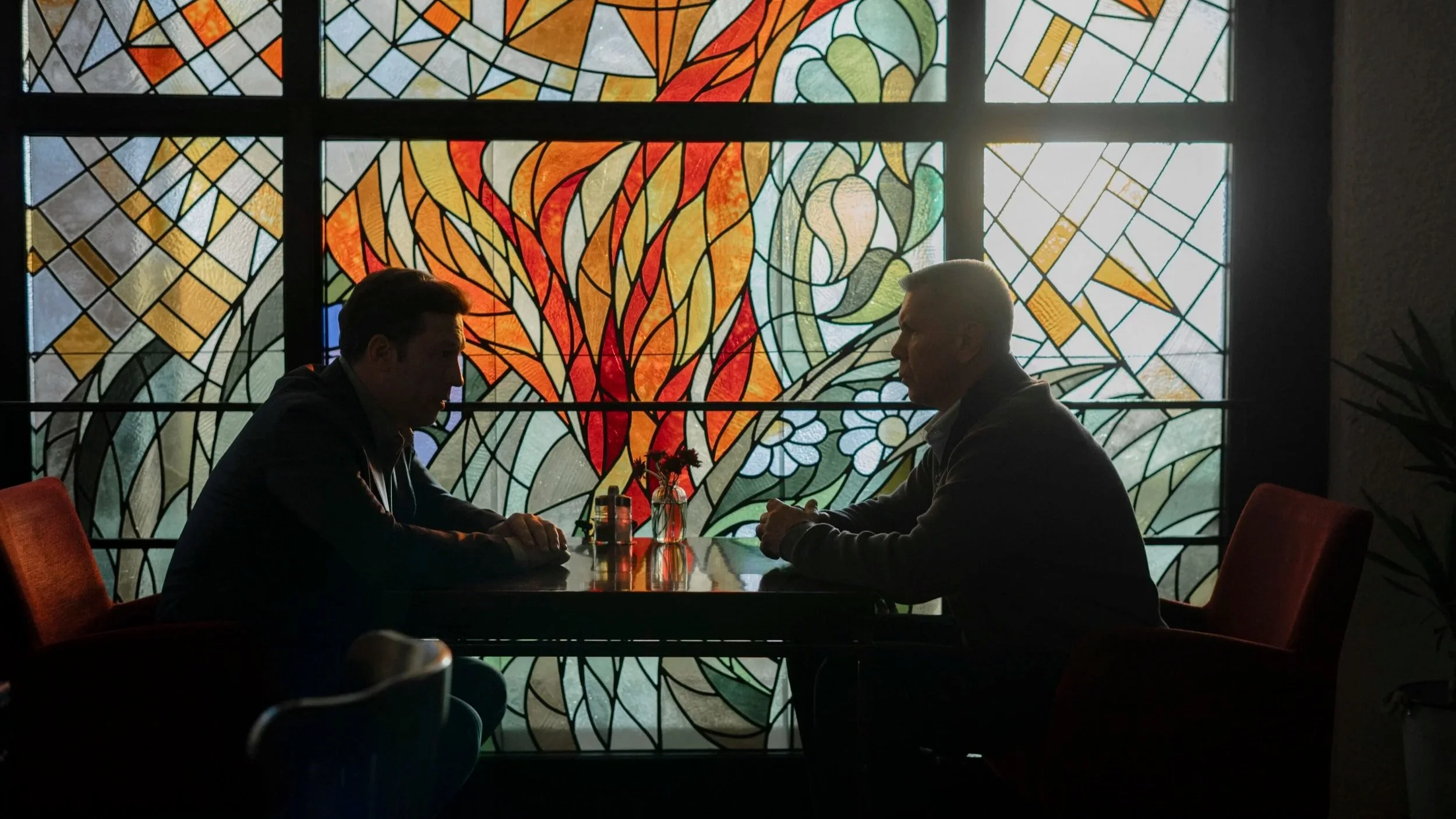
Minotaur triumphs because behind this personal crime drama lies the condemnation of the current Russian political atmosphere. When the Mayor (Vladimir Friedman) informs the top employers in this small town of the number of employees required to military conscription, this is all done under a small, mounted picture of President Vladimir Putin. Zvyaginstev firmly suggests that only in a country this corrupt are its most affluent citizens allowed immunity from all of their criminal actions. The film’s final shot of overcast clouds from above suggests that the world is grey because some things are morally black-and-white.
If you enjoyed this article, please consider becoming a patron of Hyperreal Film Journal for as low as $3 a month!
Paul Feinstein is an arts professional who has produced content in different mediums including film screenings, live music, radio, and theater. He is a native Austinite.