
Saved!, Easy A, and the Making of a Compelling Zealot
Introduction
The overzealous Christian is a recognizable stock character: think Arthur Dimmesdale, Margaret White, Frollo; secondary characters in TV shows like Quinn Fabray in Glee, Ann in Arrested Development, and Mrs. Kim in Gilmore Girls; or films and TV shows highlighting real-life (or lightly fictionalized) televangelism empires like The Eyes of Tammy Faye and HBO’s The Righteous Gemstones. In the United States, a country where a subset of far right-wing evangelical Christians has grown steadily in cultural and political power over the last 50 or so years, perhaps it’s understandable that we seem to love returning to this archetype in the media we consume and create.
These characters–generally overbearing, holier-than-thou, convinced of the rightness and supremacy of their beliefs–tend to represent conservative, restrictive forces in their stories’ universes. They’re hostile to those who are different (when they aren’t actively trying to convert them) and thus posited as the antithesis of progress and pluralism. Their arc tends to involve some sort of crisis of faith: generally, being forced to reckon with a hypocritical contrast between their desires/actions and their religious credo—maybe even learning some sort of lesson about acceptance along the way—and they rarely, if ever, emerge triumphant and unchanged in the end.
Perhaps two of the best known twenty-first century Christian zealot characters appear in teen comedy films: Hilary Faye Stockard (Mandy Moore) from 2004’s Saved! and Marianne Bryant (Amanda Bynes) from 2010’s Easy A. Both Hilary Faye and Marianne are the queen bees of their respective high school cliques–antagonists who spend most of their screen-time casting aspersions on the female protagonists (Mary Cummings [Jena Malone] in Saved! and Olive Penderghast [Emma Stone] in Easy A) for their perceived unholy transgressions. But, while Saved! Is one of my all-time favorite films, I found Easy A to be a letdown, despite the fact that the films have a lot in common. Why? One big factor is the difference in each script’s treatment of its zealots. I’ve long held that Saved! succeeds where Easy A fails in this regard, and in this piece, I’ll revisit these movies to explore why that is.
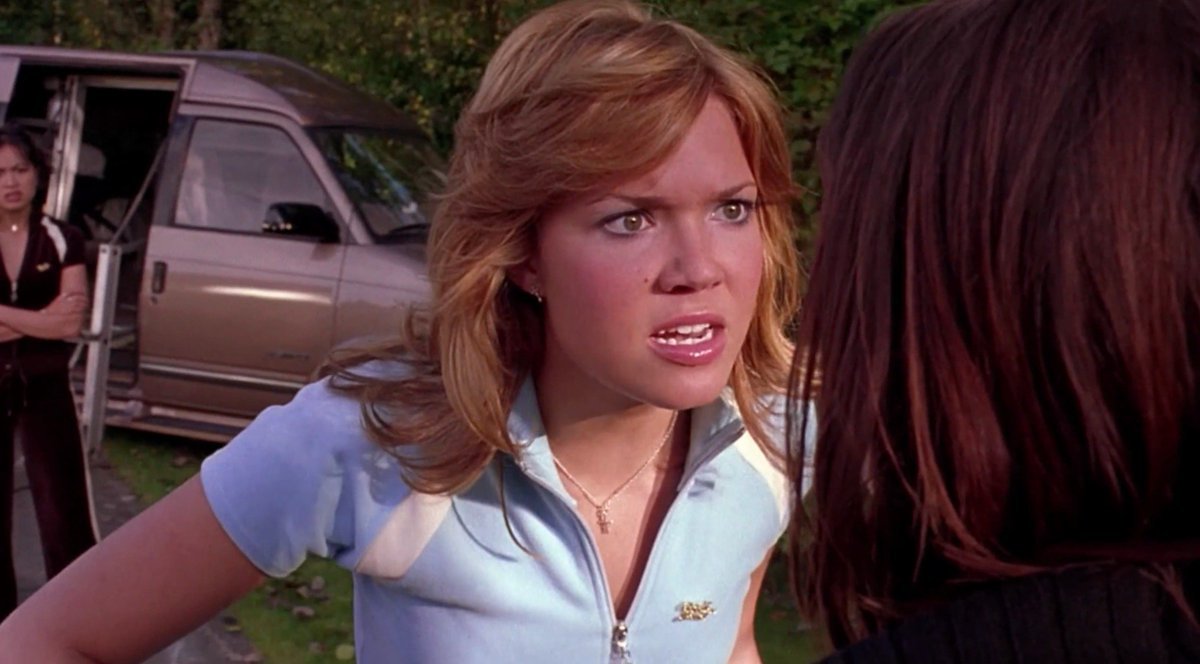
You’ve heard of Bible-thumping…now get ready for Bible-throwing.
The Films
At the start of Easy A, 17-year-old Olive lies to her friend Rhiannon about losing her virginity to a (made-up) community college student. Their conversation is overheard by the pious and judgmental Marianne, leader of the school’s Christian club, and from there, the school rumor mill greatly exaggerates Olive’s alleged sexual exploits, giving her a reputation as (to use the movie’s parlance) a tramp/skank/slut/etc. This notoriety is cemented after Olive agrees to (pretend to) have sex with her gay acquaintance Brandon in order to convince their peers he’s actually straight, in exchange for a small payment. Soon, boys from school start making similar furtive arrangements with Olive, and she decides to embrace her new promiscuous image—acquiring and donning a wardrobe of lacy bustiers emblazoned with a red letter “A,” à la Hester Prynne in The Scarlet Letter (which she happens to be reading in English class). Eventually, Marianne’s boyfriend Micah contracts chlamydia and falsely accuses Olive of being the one who gave it to him—culminating in Olive doing a live webcast to dispel the rumors once and for all, before driving off into the sunset on a riding lawnmower with Todd (Penn Badgley), the boy she’s had a crush on the whole time (and who never doubted her integrity).
Saved!’s action begins when devout high school senior Mary’s boyfriend Dean confides in her that he thinks he is gay. Believing that she is being called by Jesus to “cure” Dean of his homosexuality, Mary has sex with him, losing her virginity in the process, and discovers she is pregnant shortly thereafter. Dean, meanwhile, is sent to a “Christian treatment center” after his parents find gay porn under his bed. Frustrated that her attempt to “save” Dean was unsuccessful, Mary begins doubting her faith–leading to ejection from her former best friend Hilary Faye’s club/clique The Christian Jewels and ostracization from her fellow students at the Christian high school she attends. From there, she is taken under the wing of two school outcasts: Roland (Macaulay Culkin), Hilary Faye’s black-sheep brother, and rebellious Jewish alt girl Cassandra (Eva Amurri). Hijinks (and, of course, an early-aughts shopping montage) ensue and Hilary Faye’s rivalry with Cassandra and Mary escalates to the point of Hilary Faye framing them for spray-painting anti-Christian messages on school property, leading to their expulsion and the reveal of Mary’s pregnancy to the student body. It all comes to a head on prom night: our leads expose Hilary Faye’s scheme; Dean, having broken out of the treatment center (along with his new boyfriend and other patients), shows up to attend prom; Hilary Faye has a dramatic existential crisis/meltdown; and Mary goes into labor, just in time to give birth with a supportive and accepting community around her.
Like I said earlier, these films share a good deal of similarities: both have a high school setting; both clock in at a little over 90 minutes long (with Easy A at 93 minutes and Saved! at 92); both explore themes of societal preoccupation with female sexuality and social shunning; and (of course) both movies’ antagonists are zealous Christian young women. So what is it exactly that Saved! gets right that Easy A doesn’t? Let’s break it down.
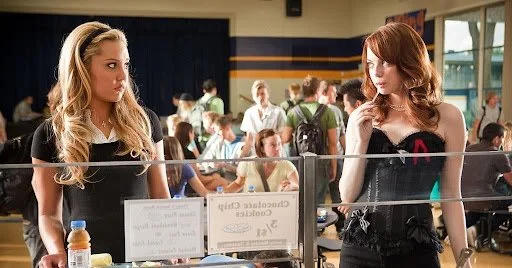
Presented without comment.
The Analysis
I suppose now is as good a time as any to state my “qualifications” (such as they are) for making this sort of analysis. I went to private Christian schools in north Texas for the entirety of my primary, elementary, and secondary school career. The majority of those years (ages 8-17, if you can believe it) were spent at a school very much like Saved!’s American Eagle Christian High–like, down to the fact that our mascot was also an eagle. On Sundays, I attended youth group at an aspiring megachurch.
My school’s chapels and church’s services had the ecstatic, “modern” music-backed worship style and adults-trying-desperately-to-be-hip preaching tone that Saved! lampoons. I played keyboard in the school praise band, like Mary. My church regularly dispatched youth group members to hand out religious tracts on street corners. People actually spoke in tongues during particularly intense worship sessions. The thematic undercurrent in the lessons my teachers and youth pastors alike instilled in my peers and me that we were foot soldiers in a holy war that was being waged in our lives daily; our mission was to resist the temptation from Satan to sin, as well as to concern ourselves with the salvation of (read: try to convert) those who did not believe what we did—thus, we were told, saving their souls from an eternity of torture. In other words, to borrow a phrase from Saved!’s Pastor Skip (Martin Donovan), each of us was meant to be a “warrior on the front lines for Jesus.” Suffice it to say, I grew up immersed in the evangelical Christian milieu, so I’m a pretty tough crowd when it comes to media depictions of these environments.
Settings
The settings themselves are, I believe, a big factor in these films’ effectiveness in telling their stories. While Saved! takes place at a private Christian high school in Maryland, Easy A is set at a public high school in California. As such, right off the bat, these stories have vastly different stakes. Hilary Faye–Christian Jewels ringleader, worship band lead singer, overall golden child–enforces (and thus, comes to represent) her school’s religious status quo; Marianne, on the other hand, is merely the leader of a roughly eight-person Christian club at her large public high school–the definition of a small fish in a big pond.
No one, least of all Olive, is shown taking Marianne seriously throughout Easy A. While the narrative tells us she successfully petitioned to change the school’s mascot from the Blue Devils (which, according to her, glorified Satan) to the Woodchucks, this maneuver is the only real systemic clout that Marianne holds during the films’ runtime…and even then, most of the students are shown regarding the new mascot as silly and underwhelming. Speaking of the other students, Marianne is only shown spending time with her fellow Christian club members; her attempts to interact with students outside of this group (which generally takes the form of handing out religious flyers) tend to be rebuffed. Not even authority figures like or respect Marianne–the school guidance counselor refers to her as “that snotty Jesus freak office aide I have.” It’s implied that Marianne starts the initial rumor that balloons into Olive’s eventual bad reputation, but even then, it’s attributed more to the general “rumor mill” than any specific person. Having de-fanged its alleged antagonist in this way, Easy A seems at a loss for Marianne’s purpose in the plot altogether.
Hilary Faye, on the other hand, has prestige in her world. Rich, pretty, and poised, she’s looked to by the student body as a Christian par excellence–organizing prayer circles at her house, and entrusted by the school’s head religious leader, Pastor Skip, with the task of “guid[ing Mary] back to her faith.” Several times, Hilary Faye makes references to the fact that her father is a major donor to their school. Her untouchability is why she succeeds in framing Cassandra and Mary for vandalism: she’s aware that they, as known dissidents, are easy scapegoats for the crime, and that no one would ever suspect her.
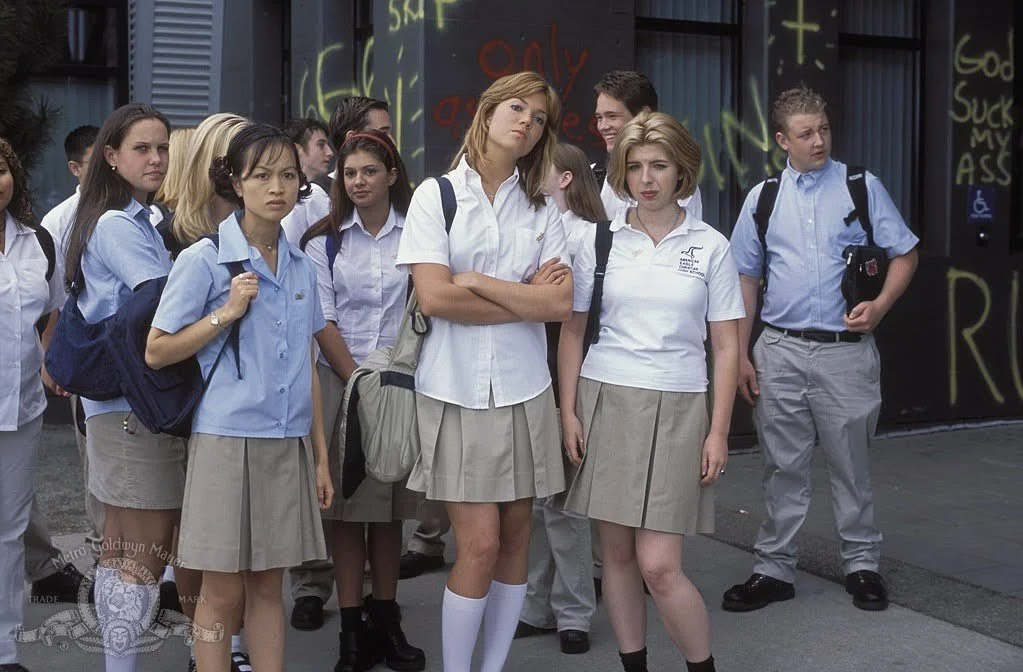
I deserve compensation for this film forcing me to recall wearing khaki uniform skirts just like these.
Character Motivations and Arcs
Now that we’ve examined Hilary Faye’s and Marianne’s place in their respective settings, let’s talk about why they do what they do. Why would any teenager–members of a cohort famously concerned with self-image and peer acceptance–want to align themselves with repressive forces?
By way of context, it is worth noting that any evangelical Christian teenager will have been told countless times by their religious leaders to be “in the world, but not of the world.” This reference to Biblical scripture (John 17:14-16) is meant to convey that, while Christians exist in the earthly realm, they should resist being worldly; their “born-again” spirit should mark them as set apart, transformed. Under this philosophy, evangelical Christians are told that it’s alright and even inevitable that they might stand out from their peers. All that is to say: it’s safe to assume that Hilary Faye and Marianne, devout as they are, would be familiar with this notion–and given the bombast with which they express their religious beliefs, they seem to have taken it to heart as a guiding principle.
I make that introduction because, well…the films vary in their ascription of believable motivations to these characters. It is never made clear why Marianne acts the way she does in Easy A: is she a true believer, oblivious to the general perception of herself as stuck-up and annoying because of her desire to convert at all costs? Maybe, but if so, the script weakens this argument when, about halfway through the runtime, it shows her plotting (in the middle of an initially earnest-sounding “prayer request” for Olive) with the Christian club to “get rid of [Olive].” Why? Keep in mind that this scene takes place before Marianne is led to believe that Olive slept with her boyfriend—so up to this point, we’ve been presented with no real motivation for Marianne’s actions except a concern for Olive’s soul (if she genuinely believes what she espouses in prior scenes) and/or, perhaps, a desire to feel superior to Olive (which we could infer from Marianne’s sanctimonious verbal barbs toward her). The desire for Olive to be wiped off the map entirely is thus new and never really explored beyond this scene.
Marianne’s initial disdain for Olive seems to stem from Olive being, to use Marianne’s words during her first onscreen appearance, an “admitted whore.” We aren’t given enough information beyond that to know why this sets Marianne off–it seems as though the film is content for us to fill in the blanks and assume that any Christian definitionally hates sexual promiscuity, no further explanation needed. In the movie’s last act, we’re introduced to some actual stakes for the character when Micah accuses Olive of giving him an STI. Marianne is of course angered, hurt, and betrayed by this. Her response? To organize a laughably small “protest” against Olive (complete with signs emblazoned with Bible verses or words like “SLUT!”), after which she isn’t seen again until the ending montage. As the film cuts between various characters’ reactions to Olive’s webcast (wherein she has just revealed the truth about her alleged indiscretions and proclaimed that her sex life is “nobody’s goddamn business”), we get a brief shot of Marianne watching on her laptop and touching her cross necklace. It’s unclear what we’re supposed to glean from this shot: is she penitent, annoyed, at all changed? We never find out; the scene ends on a freeze-frame of Olive and Todd and cuts to credits.
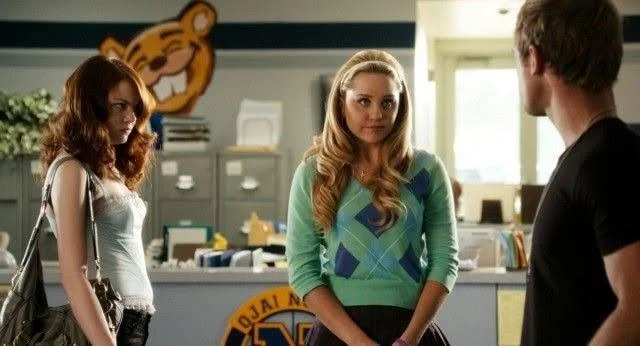
A sartorial representation of the classic battle between evil vs. good, vice vs. virtue: lacy camisole vs. argyle sweater
Saved!, meanwhile, uses much more of its runtime to explore its antagonist’s motivations and interiority. There’s little doubt as to the fact that Hilary Faye is, to a large extent, a true believer who feels immense pressure to do God’s work in the world and be an example of a good Christian young woman (in one early scene, she–spotting Cassandra coming toward them–encourages her friend group to laugh loudly and appear as though they’re having fun to “show her just how cool we Christians can be!”). She tirelessly works to “save” Cassandra, even at her most exasperated, and seems legitimately thrilled when Cassandra (as a prank) lies about wanting to pray with her to be “born again.” When Hilary Faye eventually graffitis the school in order to frame Cassandra and Mary, this action is preceded by a scene of her praying intensely alone in her bedroom for spiritual guidance, pleading, “They need to know that what they've done is wrong. Please, Lord, please. Just tell me what I need to do.”
But even if we as viewers haven’t analyzed Hilary Faye’s motivations up to this point, the film forces us to consider them when Roland point-blank asks her, right after she’s successfully gotten Mary and Cassandra expelled, “You have everything, Hilary Faye. What are you afraid of?” The very next time we see her, it’s during a musical montage wherein all of our leads reflect on their situations–with Hilary Faye shown staring pensively (regretfully, even?) out her bedroom window at the night sky.
After her actions are exposed at prom, toppling her queendom, Hilary Faye fully melts down. As she recklessly drives her car through the school parking lot, she bitterly lists off the Christian responsibilities she feels she’s been saddled with her whole life (“Save the heathens, Hilary Faye…be a warrior, Hilary Faye…sacrifice everything, Hilary Faye!”) before yelling, “And here's your big, fat, stupid reward!” and purposely accelerating her car into the school’s large wooden effigy of Jesus. Any outsider can see that Hilary Faye’s actions throughout the film are misguided and cruel; this scene and her overall character arc confirm the pressures that made her feel it was necessary to take them. While the movie leaves no doubt that she enjoys her high standing in the school’s social hierarchy, Hilary Faye’s breakdown shows the toll religious-community-imposed expectations have taken on her–without letting her off the hook for the harm she’s caused others. She, like all the film’s characters (even Pastor Skip), is shown by the end to be just a person searching for the “right” answers for how to live life…and making bad, misguided choices along the way.
Conclusion
When Easy A writer Bert V. Royal was asked in an interview with Jacksonville.com, “Is there a more serious message behind Easy A?,” he responded, “You know, there really isn't. I guess if there is a message to come out of it, it's mind your own business. We tried so hard not to be preachy…” This quote underscores the script’s overall directionlessness—which is perfectly demonstrated in Marianne’s lack of character development, scrutable motivations, and utility to the film’s plot.
Hilary Faye, conversely, is key to Saved!’s story. She drives much of the action and serves as a representation of the high standards our characters are held to in the religious environment that surrounds them–as well as the outcomes (social rejection, expulsion from school, and even being sent away to conversion therapy) that await those who fall short. Because of this, I would even argue that Saved! is the better The Scarlet Letter analogue of the two films (though Easy A is the one that deliberately adapts its story).* After all, Hester Prynne, like Mary and Saved!’s other misfits, is shunned by her religious community, which oversees all the social structures she lives within. Easy A presents no such far-reaching social order; Olive’s parents are shown to be progressive and permissive (and never mentioned to be religious) and she goes to public school. In this context, Marianne and the Christian club, unlike Hilary Faye and the Christian Jewels, are a deviation from the “norm,” not an extension of it.
Given all of this, it’s hard not to feel as though Marianne is a pale imitation of a character like Hilary Faye; she is positioned solely as a foil for our protagonist and someone for the audience (and Olive) to laugh at. Easy A seems to have no interest in understanding what makes this sort of character compelling. Saved!, by contrast, imbues Hilary Faye with complicated motivations and feelings, as well as proximity to institutional power—all of which provide the necessary stakes for its story to work.
Near the end of Easy A, Olive makes the following statement: “That’s the one thing the movies don’t tell you: how shitty it feels to be an outcast.” In response to that, I would say: there’s this film from 2004 called Saved! that does a pretty damn good job of conveying that message to its audience, via fleshed-out characters and effective storytelling. In offering us the perspective of those cast out of the fold–as well as, surprisingly enough, those who do the casting out–Saved! tells an affecting, funny, and authentic story of young people figuring things out, finding themselves, and figuring out how to be there for each other. (Hilary Faye’s final action in the film, after all, is to accept assistance from Cassandra as she hobbles away from her wrecked car. As the two characters walk off together, Hilary Faye leaning on Cassandra for support, Cassandra–unknowingly providing the audience with hope for Hilary Faye’s redemption–says, “She’s gonna be okay.”)
*This may be partially because, according to Royal in this video interview, he has not read The Scarlet Letter.
If you enjoyed this article, please consider becoming a patron of Hyperreal Film Journal for as low as $3 a month!
Liz is a Chicago-based film enjoyer, crocheter, and Hyperreal Film Journal editor. Find more of her thoughts on movies (mostly those with killer soundtracks) @espieck on Letterboxd.