
AFF '25: Interview with Matt Litwiller and Collin Davis
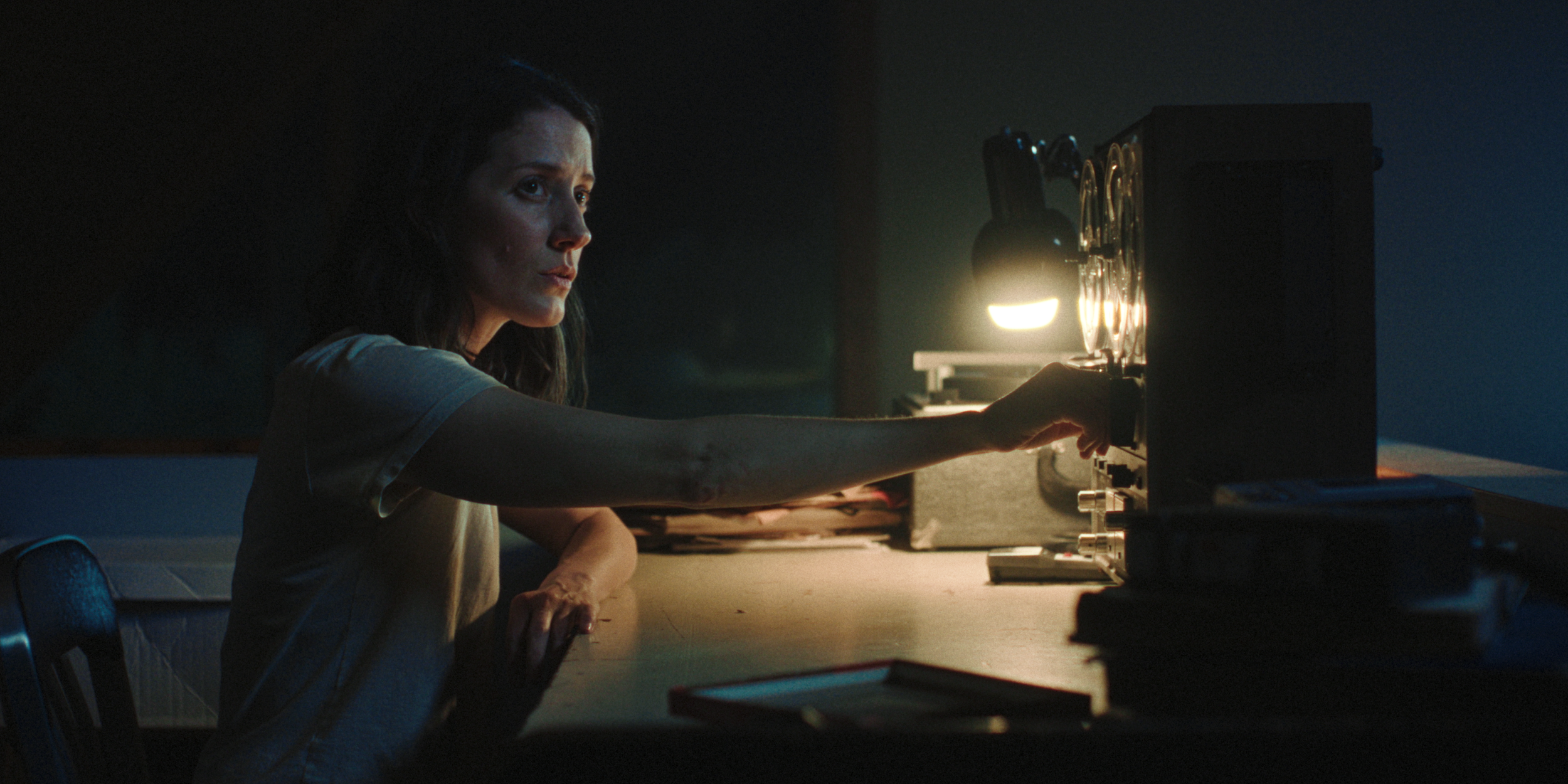
In All The Way Down, Alex, a talented young composer (Teri Wyble), is driven to obsession when her estranged grandfather wills her his lakeside property with a mysterious note: "The water is the music." Premiering at Austin Film Festival in the Dark Matters Feature category on Friday, October 30, All The Way Down is a surreal, atmospheric depiction of music, obsession, and family secrets.
In advance of their world premiere at the Austin Film Festival, Hyperreal Film Club sat down with co-directors Matt Litwiller and Collin Davis to talk about their influences, the benefits to shooting projects outside of Los Angeles and New York, and their strategy for asking a sound designer to make an "otherworldly, indescribable sound that could drive someone to madness."
Hyperreal Film Club (HFC): I was curious about y'all's background in music since the movie's has such a focus on sound and it follows a composer. You talked earlier about how this story's been marinating for you both for years.
Matthew Valdez-Litwiller (MVL): I can answer for myself and offer a little about how music's brought us together. So I played in my school orchestra from I think 10 years old to college, and even though I grew up in a small town, there was a program director who was super passionate about it. She would get us to state every year, and we'd play really challenging material. And so, that always left a deep impression on me, the mystery of old music, and the centuries of people playing classical works and what people discover over time. There's such an obsession that goes into it for people, and for Collin [Davis, co-director and co-writer] and I, when we met in college, and when we started making stuff together, a lot of times the way we would figure out tone or what we were going for through playlists or through music. We'd have a feeling that we would get from certain aesthetics of a music track or the album cover or the music video. I think from there we could figure out our story, so we've always communicated musically through the creative process, and this film was a very natural way to bring that to the surface.
Collin Davis (CD): Yeah, I'll back that up. I think in the early days, Matt and I were pretty different people. I mean, we've aligned over the 10 or 15 years of working together, and our tastes have more in common. But we come from different backgrounds, and I think when we couldn't describe things to each other, we could play each other music, and speak to each other through a feeling of sound. As far as musical background on my part, I did some band and orchestra in high school. But I think where I really started to come into more interesting stuff was in college. I had a radio show at WNUR, our college radio station, and one of their big things was promoting more challenging music. One of our shared friends, Doug Kaplan, was the head of the radio station, and was into super weird music, and I was being pushed to open up in a new musical direction on this radio station. My job was to share what I found with other people: atmospheric stuff, strange electronic stuff, old stuff. It felt like a mission that was worth pursuing.
Music and sound is just so important to our creative output. So it started there.
MVL: And I want to add that Collin's show was at 1 a.m. or something. Those were prime hours of just talking about any given existential question. So we would just hang out in the radio station and he would just pop on the mic every five minutes, and in between tracks we would just listen and talk about creative ideas. And then that carried over into adulthood. And one of our executive producers, Scott Williams, he was a music major and can speak really well to the history of classical music. I think it was at a bachelor party for our cinematographer. We stayed up all night listening to Mahler and getting an education from Scott on a bunch of operas because Collin and I had never really been into opera. And that's where he got excited about the idea for the film and decided to get involved and help.
HFC: I guess having a late night radio station that you're just sending out into the aether for anybody who wants to hear it has a bit of resonance with the movie. So with that, you both have a background in music, and your executive producer is an expert. So how did you go creating the sound with [sound designer] Mariusz Glabinski? Did you all have an idea in your head that you were trying to express through other music, or did you go the David Lynch route of just describing the vibe, or did you leave him to explore on his own and give him feedback from there?
MVL: Yeah, it was a big journey that turned into a big team effort. We worked with Mariusz, and then we worked with [composers] Zach [Robinson] and Dan [Light], and then we worked with our re-recording mixer and sound supervisor Steve [Bucino, supervising sound editor & rerecording mixer], and all those different people added something or took what the previous had done and shifted and warped and layered it. So the final sound is a real amalgamation by the end.
CD: I would say on a script level, when we wrote the movie, we were describing something that's unknowable, huge, deep… all these descriptors that are maybe the hardest thing to give to someone to create. "Here's a incredible sound that will drive you to madness. Please go make this." So it was something that we had to shape from and carve from influences that we brought in. You have to communicate with your influences. But then we also gave everyone room to put their own spin on things because we don't know what we don't know and we don't know what they might be hearing themselves. I think the best parts of what we got are things that other people brought.
Mariusz gave it this atmospheric creaking that feels that it disseminates in the atmosphere when the sound is happening. Zach and Dan gave it this Close Encounters-esque, almost melodic structure, and Steve put it in the space and made it huge. Everyone put their particular stamp on it.
MVL: Yeah, and Steve did a really great job of taking those pieces and then spreading them out in different, hidden ways. So there's a lot of different spots throughout the movie where Steve's layered in parts that you're just perceiving it in the background, or adding a ton of reverb. So, you're just feeling the tail of the sound, or hearing it blended with a train horn or other things.

HFC: I really appreciated, as a big fan of indie cinema that doesn't take place in LA starring people who can afford to pay rent every month, I appreciate that a lot of this was shot in the Midwest, and that it was something that y'all were committed to. Could we chat a bit about opportunities that shooting outside of LA and New York can bring to a film, and some of the challenges that might come with crew and budget and location?
CD: I don't want to down talk LA and New York, but it is hard to shoot in LA and New York on a budget. I just don't think it would be possible to do it. Certainly, at our budget level, with the scope that we wanted. And just location-wise, there's no lake house in Los Angeles, so we had to get out and and get searching for it. I think as far as the benefits of shooting outside of those places, there's a lot of energy that people bring when you're doing a creative project in a place that doesn't have something like that happening all the time. It's much more exciting for your team and the people in the town area are excited that you're making it. People are interested in helping you be creative and adding what they can to the process. So, it's amazing actually to shoot outside of LA.
MVL: Yeah, it's nice to be a novelty instead of a nuisance. When the budgets get bigger, you're usually chasing tax incentives, but then chasing tax incentives leads to cheating this location for that location. Maybe the average viewer doesn't necessarily perceive that one shot or another is shot in a different state or country, but I think they can still feel it. What makes independent film powerful is that you can feel the more naturalistic vibe because it's out of necessity. Like the countryside B-roll shots or the lake itself with the huge clouds in the sky… if we cheated it in California, you'd know. You just don't get clouds like that because the thunderstorms in the Midwest are just so much more insane. I think it feels more true to the story and the history that we're getting at. Even though it's a fictional history, it's rooted in some general aesthetics of where I grew up and stories I had heard, and it's nice to culturally place yourself there.
HFC: As co-writers and co-directors, what's your specific way of collaborating and working together?
CD: I think over the years, honestly, Matt and I have taken on all jobs at equivalent levels. It's just such a Herculean task to do a film, so we were just spelling each other all the time. One person has a lot of energy in one moment, and the next person takes the energy from them, and does that on a creative level. I think often we're not 100% aligned, and what happens is we have a place where we don't see what the other person sees, and we have a discussion about it, and then we get a third thing from that. It wasn't what I thought or what he thought. It's this third thing that we decide on, which is usually better. So it's having two brains that get to digest an idea that leads to an idea that would have never been there from just the one brain.
MVL: Yeah, like in grad school, you have to defend your dissertation. We're trying to get through a creative obstacle or a logistical obstacle or whatever, so we have to say why we want to do something. I think maybe a lot of people who work on their own, they just have that conversation with themselves. But, it's nice to have someone to challenge you and say, "Well, that doesn't make sense to me. This is how I see it."
CD: Yeah, we get to challenge each other, which is good. I mean, it can also be contentious, but here we are.
MVL: Yeah, and I think it also makes us more collaborative in a broader sense because then we were working with our cinematographer, who's helping bring his third opinion that then can push things in a certain way. We edited together, but we brought in our friend as a third editor, who also was playing that role. Same thing with every different stage: the music, the production design, et cetera. We're always collaborating with another crew head or a team member who's helping bring something that's triangulating things.
HFC: I also wanted to talk about some of the influences on the film. Did y'all have north stars that you were thinking of? Something like, "It would be great if we could capture this feeling or this vibe?"
CD: I would say Take Shelter, the Jeff Nichols film. That's a huge influence, on us and on this movie. It's about a singular character confronting a fantastical element that either is or is not real, based on how you're viewing it in the moment. And tonally, it has such a component of dread. That one has always really sat with us. We weren't writing with it in mind, but it's always just been there as one of the key references. I will also say that Matt and I, we talked a lot about [Andrei] Tarkovsky movies that are super atmospheric and all about dream spaces, and I think that soaks into everything we do a little bit. They have this slow, methodical atmosphere component that make Solaris or The Mirror so aspirational for us.
MVL: I think another big inspiration was a Texas film, A Ghost Story, directed by David Lowery. I think like Take Shelter, it was very inspirational in how it took a small cast and rural setting and still had such scale and a genre element to it where it felt like there was something fantastical onscreen. It wasn't so much about scaring you or aliens showing up, or anything over the top, but more just an underlying existential question with strong performances. I think that helped us build a template for achieving a bootstrap genre film.
CD: Yeah, I think another one worth mentioning is when we were just starting to write the script, we were really into Portrait of a Lady on Fire. There's something about the existential question of that movie, and especially the scene where the women are chanting in an almost witchy way around a bonfire, out in the countryside, and that had an alignment with some of the ideas we were trying to get into our film.
HFC: And my final question: How are your relationships with your grandfathers?
CD: Mine have both been deceased since I was a young child, so they're very theoretical in my mind. They're distant mythical figures to me, so that might be what we're feeling in the movie a little bit.
MVL: I really only had a relationship with my dad's grandfather, and he was a farmer in Central Illinois, but a very sturdy citizen, pillar of the community guy. But it was definitely a world that was very distant to me because, while I didn't grow up in the city, I was very much in suburbia, and going out to the farm always felt unique. How quiet it was out there, and how much vast empty space there was always unnerved me, and I think some of that makes it into the film. Being out there, there'd always be talk of an abandoned barn or this abandoned property or this strange family in the woods that people don't talk to. It just leaves a lot to the imagination.
You can catch All The Way Down on Monday, November 2nd at the Bullock IMAX Theater at 5:00 p.m.
This interview has been lightly condensed and edited for clarity.
If you enjoyed this article, please consider becoming a patron of Hyperreal Film Journal for as low as $3 a month!
Ziah is the founder and former editor-in-chief of the Hyperreal Film Journal. He can usually be found at Austin Film Society or biking around town.