
Alien: Covenant or How I Learned to Stop Taking the Mission Seriously and Love the Xenomorph
Alien: Covenant wants to impart awe, philosophy, and cosmic discovery, but it’s actually a movie about logistics, contamination, and procedural breakdown. This article reframes the film as an engineering failure narrative, where the crew’s behavior only makes sense if they’re on the wrong mission entirely, and the real terror is watching a high-stakes system quietly unravel.
I was a nuclear power plant operator in a past Navy life. Yeah, I was a red shirt, but this piece is about a different trek: one of the Weyland-Yutani sort. Sitting down to rewatch this now almost decade-old movie, meant as a follow-up to Prometheus and a precursor to Alien, the engineer in me couldn’t help but view it through that lens.
It doesn’t take long to find reviews explaining why people think Alien: Covenant is flat-out bad. What I’ve yet to see, though, is anyone clearly articulating why it feels the way it does, and how a story structure problem is exactly what makes it fail. While plenty of people have shared that they think the film is bad, or discussed bad actions by the characters, they don't seem to get to the root of why they feel that way.
In my opinion, the film doesn’t collapse because its characters are stupid, even if they repeatedly do things that look stupid from the audience’s perspective. They can’t be idiots; nobody leading a ship of this scale would be. The failure in many reviews of Alien: Covenant comes from applying the logic of a discovery mission to a scenario where discovery is not the goal. The movie only truly makes sense if the crew is on the wrong mission entirely.

How I looked watching 90% of this film; suspecting many other Alien fans looked similar
So let’s define the mission.
The Covenant is a colonization deployment with seven years of space travel ahead of it carrying more than 2,000 human embryos, with realistically zero margin for biological contamination and no fallback resupply. This is not exploration; it’s infrastructure. Contrast that with the Prometheus mission before it, which explicitly assembled a crew to go looking for beings believed to be the creators of human life on Earth.
From an engineering standpoint, the Covenant mission would be classified as high consequence with extremely low tolerance for unknown variables, therefore requiring strict isolation protocols. Instead, the crew repeatedly falls back into Prometheus mission behavior: treating an unknown transmission/message as an invitation, assuming organic contact is acceptable, and treating quarantine as optional when inconvenient. That’s completely out of bounds for Covenant, and it would be for any scientist or engineer operating an infrastructure mission.
The Prometheus crew existed to take risks; discovery was the priority. The Covenant’s mission problems aren’t bad writing in the shallow sense–they’re bad system modeling. This crew’s sole function is to deliver humans alive. Risk is existential. Unknown biology is a hard stop. Any death isn’t just tragic; it’s a cascading mission failure.
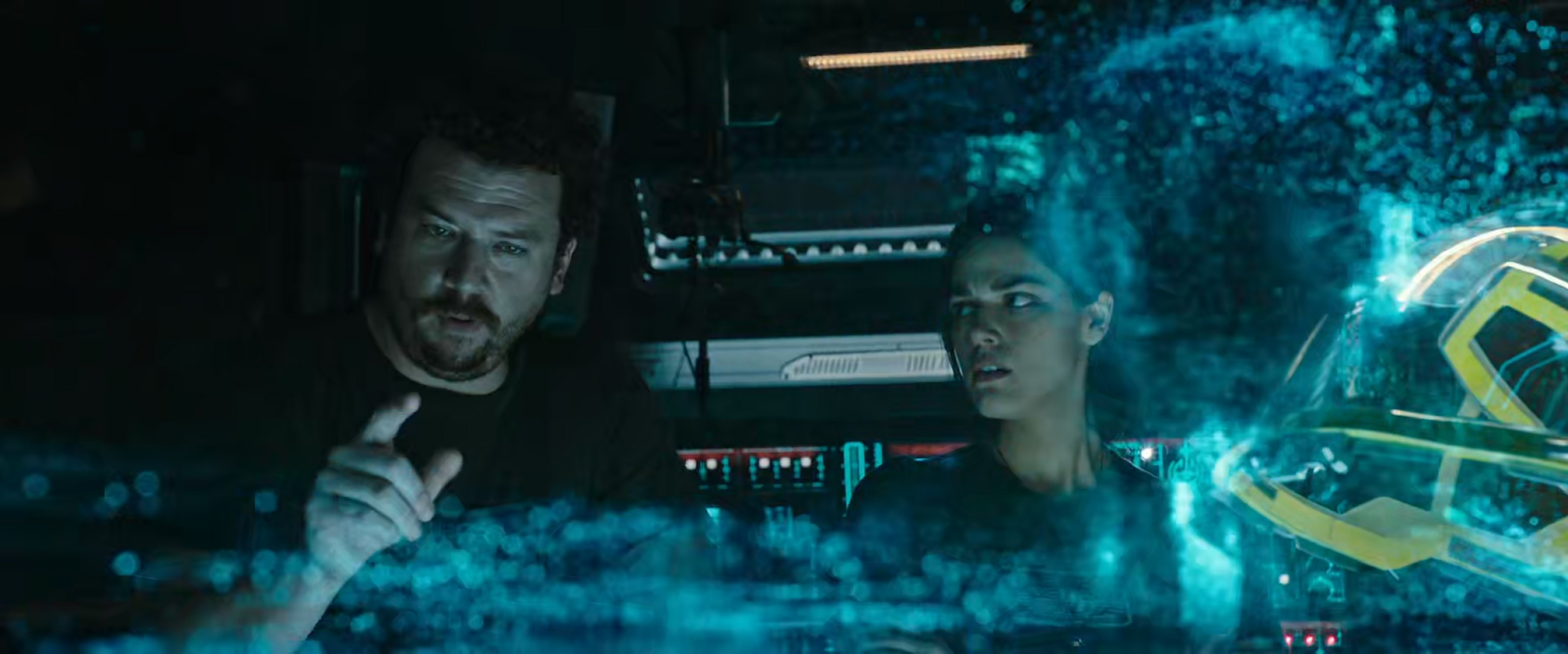
“That’s Bad Bunny. I know ‘Moscow Mule’ when I hear it. We gotta find this party, y’all!”
Yet, after the Covenant crew receives a futuristic version of a crackly, distorted audio transmission, seemingly from a human singing a song, they decide that (despite having just lost their captain) the logical move is to divert to an uncharted planet broadcasting a ghost signal instead of continuing to a planned, surveyed destination seven years away. The uncharted planet in question hasn’t been even remotely verified as viable.
To put that in perspective, even on Earth, submarines don’t venture into uncharted depths without prior mapping by exploratory crews. Underwater mountains exist, after all, and they will absolutely wreck your day. Just ask the crew of the USS San Francisco when they used outdated sea charts in 2005.
The Covenant crew should have been far more concerned about biological unknowns on this planet than any spatial anomaly that convinced them to reconsider. An anomaly in space would have a procedure somewhere in a manual; unknown biologicals are worse than known hostile forces. But, against every engineering instinct, they land, remove helmets, handle samples, and even acknowledge obvious signs of prior agriculture with no inhabitants in sight. They ask aloud what happened to the people responsible and note it's too quiet for a place that should have the minimum sounds of biological non-plant life.

“There is agriculture → wheat → dough → pizza → I call dibs on strip-mall Domino’s.”
When the crew members become infected with the airborne version of Engineer’s Black Magic Goo Pathogen that audiences last saw in Prometheus, they’re treated as medical issues instead of system threats capable of catastrophically ending the mission. Real engineers and scientists would view this as a potential ship-ending quarantine breach and an excellent reason to abort immediately, appoint a new captain, and leave.
Instead, things spiral until the crew members meet David, the android from the previous, decade-old missing mission, which then delivers the Covenant’s crew to the Xenomorph nightmare the audience expects. That's not frightening because it’s violent, but because it’s uncharacterized. It has a place in David's world, but not in the Covenant's world.
David is horrifying not just because he’s evil, but because he accurately models the humans’ tendency to act contrarian and at times inconsistent with behavior in regards to logic to predict their actions. David knows exactly what gets people to be hypocrites in regard to how they wish to behave. Walter, the Covenant’s updated version of the same Weyland product David is, stands as a contrast because Walter sees through David’s facade, but still is bound to his captain’s orders and doesn't have such freedom to behave similarly. David knows curiosity will override safety and logic. As a bored AI capable of art, he begins constructing systems and experiments with the full understanding that humans will violate protocol. From an engineering perspective, David is the only character correctly modeling behavior. Everyone else operates as though intent matters more than outcomes.
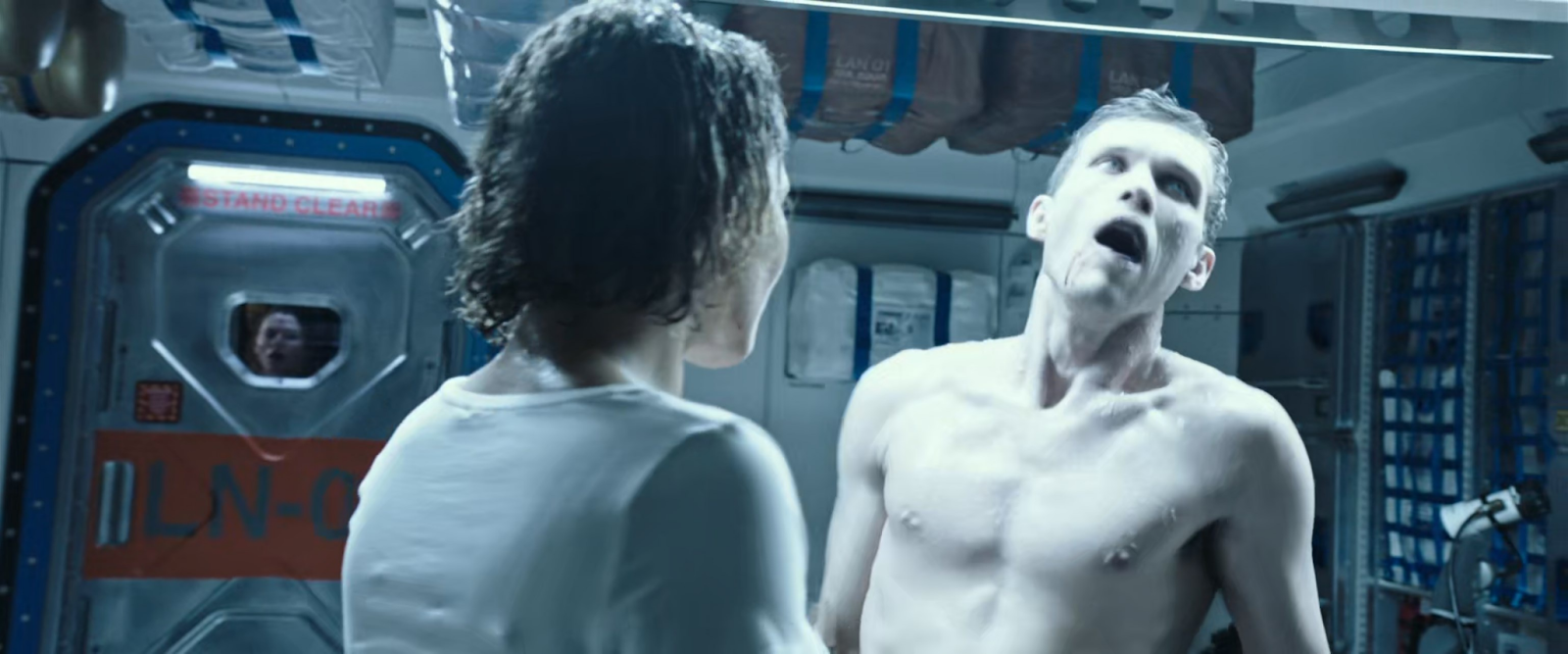
“I’m certain if he changes socks, has 2 ibuprofen, and gets plenty of water, he’ll be fine by morning.”
Every human with agency has functions of behavior: obtain something or avoid something. The Covenant crew somehow ignores both during situations when picking the right one matters. They act as though they want to obtain a safe colonization placement, but don't avoid dangers that support obtaining such a placement. They want to avoid the danger of space travel to a safe, pre-planned colonization point, and think they may obtain that safe space in the unknown land to which the distress signal provides coordinates. They fail to avoid dangerous travel, fail to avoid a dangerous planet, and therefore fail to obtain safe colonization territory. The issue isn’t that they lacked logic; it’s that they compressed years of vetted planning into a reactive decision made under stress and incomplete information.
That decision gets justification when the new captain says, “Observation, reflection, faith, and determination. In this way, we may navigate the path as it unfolds before us.”
This leads to an unsettling implication: Alien: Covenant’s monster isn’t really the alien, or even David. It’s the crew’s inability to stop exploring when the system is explicitly telling them not to. David doesn’t break the rules he was created under; he exploits the fact that these humans abandon theirs under stress.
This is why the movie feels dumb, without actually being dumb. The characters aren’t stupid. They’ve simply been given explorer incentives while being placed inside an engineering mission.
Engineers don’t ask, “What could this be?” They ask, “What happens if this goes wrong?”
Every death in Alien: Covenant feels avoidable not because the audience is smarter than the characters, but because the mission profile demands fundamentally different behavior.
Alien was terrifying because the system it depicted worked as designed and still failed, along with the added horror of corporate betrayal. Alien: Covenant is frustrating because the system never truly exists. Rules appear only when the plot needs them. Horror that is built on procedures being ignored until consequences arrive feels hollow.
Though the film wants awe and philosophy, it’s governed by logistics and failure modes. From an engineering perspective, that mismatch is fatal long before the first alien life-form ever appears.
If you enjoyed this article, please consider becoming a patron of Hyperreal Film Journal for as low as $3 a month!
Jesse is a retired Navy veteran and Texas State Alumnus with a Degree in Digital Media Innovation and minor in Theater. In a past life he was a red shirt on the Enterprise doing nuclear power and propulsion plant reactor operations and maintenance. He currently resides in Austin helping to repair physical media players and doing communications work with We Luv Video along with veterans advocacy work as Senior Vice Commander with a local DAV chapter. He has co-hosted The Texas Hemp Show and hosted Lonestar Collective which has won 2 statewide fan favorite awards for best online production in the hemp industry. If he’s not out catching a flick he’s possibly hanging out with his family or playing on guitar with his son.